Faith · Prayer · Philosophy
Belief in the Unseen: Why a Present Heart Gives Prayer Its Weight

Two people stand shoulder to shoulder in the same row. They say the same takbir, recite the same Fatiha, bow and prostrate at the same moment, and give the same salam. Outwardly nothing separates them. Yet Islam insists that what they carry out of the mosque can differ as much as a speck of dust differs from a mountain. The difference is not in the body. It is in the heart, and in whether that heart believes in, and is present with, a Reality it cannot see.
A report you may have seen, and what it is worth
A saying circulates widely online, sometimes cited from the hadith collection Kanz al-Ummal: two men pray the same prayer; one leaves with a prayer heavier than Mount Uhud, the other with a prayer not worth an atom's weight (in popular retellings, "a mosquito's wing"), and the difference between them is their 'aql, their intellect and understanding. Because this is an Islamic site, we owe you honesty about it. The report is recorded by Abu Nu'aym in Hilyat al-Awliya and by al-Daylami, but the hadith scholars did not accept it: Ibn Hajar al-Asqalani (d. 1449) graded it fabricated, and al-Busiri graded it weak. So we will not attribute it to the Prophet ﷺ.
Its lesson, however, is thoroughly authentic, and that is why the saying spread. The Prophet ﷺ said: "A man may finish his prayer and only a tenth of it is written for him, or a ninth, an eighth, a seventh, a sixth, a fifth, a quarter, a third, or half" (Sunan Abi Dawud 796, graded hasan). Allah describes the successful believers as "those who are humbly present (khashi'un) in their prayer" (23:1-2), warns of "those who pray yet are heedless of their prayer" (107:4-5), and tells us not to approach prayer "until you know what you are saying" (4:43), a verse revealed about intoxication which the scholars read as a principle for every state of heedlessness. Al-Ghazali (d. 1111) summed it up: a person is credited only with the part of his prayer he was conscious of. Even the weak report's own explanation of 'aql is instructive: the man of greater intellect was described as the one more careful of what Allah has forbidden. In Arabic, 'aql comes from the hobble that restrains a camel. Intellect, in the Islamic sense, is not cleverness. It is the faculty that restrains you before Allah.

Islam begins with the unseen
The Qur'an's description of the believers opens not with prayer, fasting or charity but with something prior to all of them: "This is the Book about which there is no doubt, a guidance for the mindful, who believe in the unseen (al-ghayb), establish prayer, and spend from what We have provided them" (2:2-3). Ibn Kathir (d. 1373) records the early explanation of what "the unseen" means here: Allah, His angels, His Books, His Messengers, the Last Day, Paradise, the Fire and the meeting with Him. Abdullah ibn Mas'ud said that no one will ever acquire a better kind of faith than belief in the unseen.
This is the metaphysical claim at the root of Islam, and it should be stated plainly, because the culture around us in New Zealand and Australia tends to assume the opposite: that only what can be measured is real. Islam says the unseen is not the absent. "No vision can grasp Him, but He grasps all vision" (6:103), and yet "We are closer to him than his jugular vein" (50:16), and "When My servants ask you about Me, I am near" (2:186). The Reality we cannot see is nearer to us than the body we can. Prayer is the daily act of turning toward it.
The Prophet ﷺ gave the standard by which this turning is measured. When the angel Jibril (Gabriel) asked him what ihsan is, he answered: "To worship Allah as though you see Him, for though you do not see Him, He sees you" (Sahih al-Bukhari 50, Sahih Muslim 8). Ihsan is belief in the unseen made practical. The person who truly believes Allah is watching does not need to be told to concentrate. His attention follows his belief.
"To worship Allah as though you see Him, for though you do not see Him, He sees you."The Prophet ﷺ on ihsan, Sahih al-Bukhari 50
Khushu: the vessel and the substance
The standing, bowing and prostrating of salah are the vessel. Khushu, a state of humble, focused presence before Allah, is the substance the vessel exists to carry. The scholars mapped it with care. Al-Ghazali, in the "Mysteries of Prayer" in his Ihya 'Ulum al-Din, named six inner states that bring a prayer to life: presence of heart (hudur al-qalb), so that the mind is not elsewhere; understanding (tafahhum) of what the tongue is saying; reverence (ta'zim) for the One addressed; awe (hayba) that comes from reverence; hope (raja') in His mercy; and shame (haya') at one's own shortcomings. Notice that none of the six is a movement. All six are states of a heart.
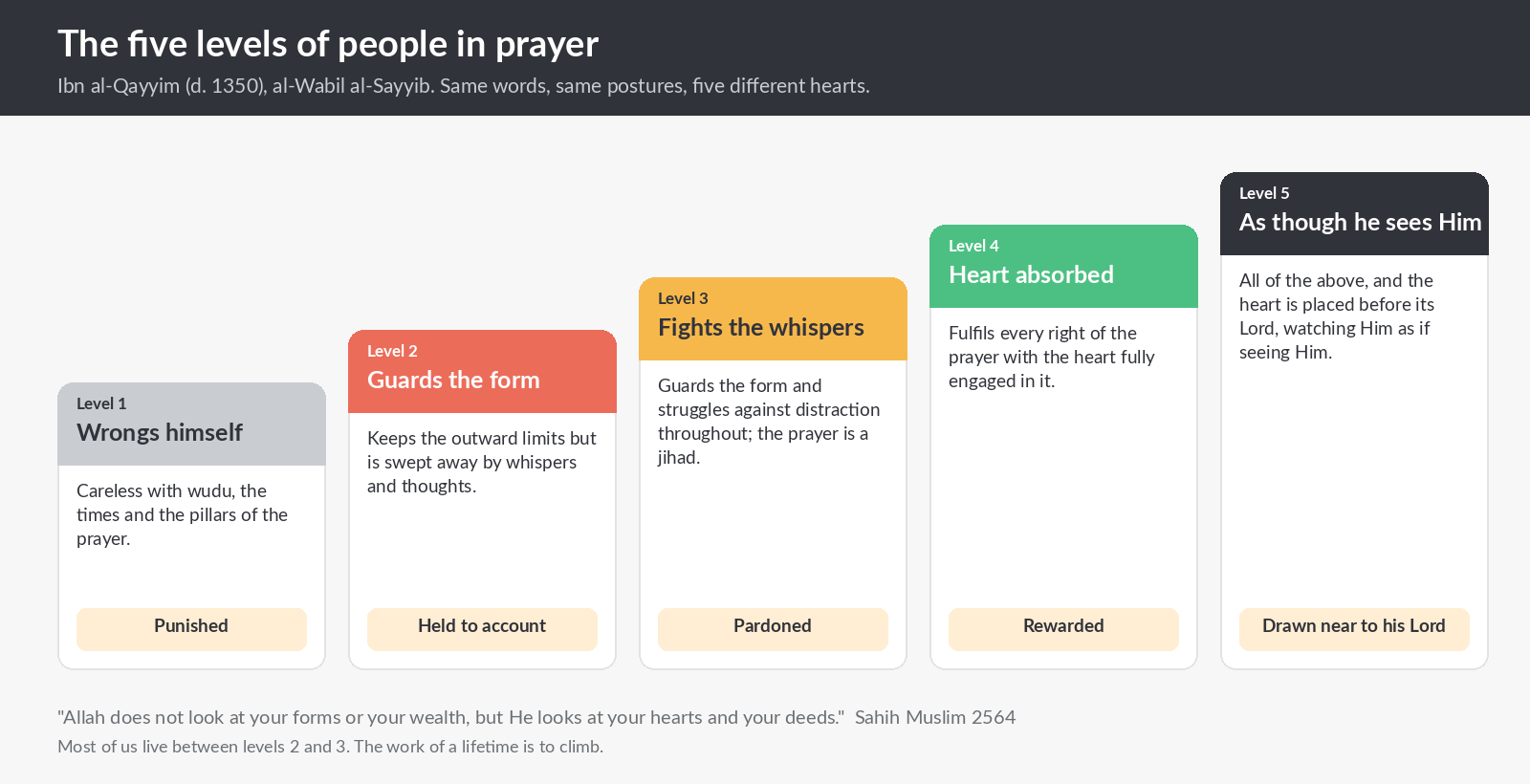
Ibn al-Qayyim (d. 1350), in al-Wabil al-Sayyib, described five kinds of people in prayer. The first wrongs himself: he is careless with wudu, times and pillars. The second guards the outward form but is swept away by whispers and thoughts. The third guards the form and fights the whispers throughout, so that his prayer is a struggle. The fourth fulfils every right of the prayer with a heart absorbed in it. The fifth does all that and places his heart before his Lord as though he sees Him. Their outcomes: the first is punished, the second is held to account, the third is pardoned, the fourth is rewarded, and the fifth is drawn near to his Lord. The same words and postures run through all five. What changes is the heart. As the Prophet ﷺ said, "Allah does not look at your forms or your wealth, but He looks at your hearts and your deeds" (Muslim 2564c).
The mind that was already present
Here is the insight that changes how you prepare for prayer. Presence cannot be switched on at the takbir. The heart that arrives at the prayer mat is the heart you have been forming all day. A mind that has spent twelve hours in the noise of notifications, arguments and worry will not fall silent because it heard Allahu Akbar. The Qur'an describes the believers as those who "remember Allah standing, sitting and lying on their sides" (3:191), and it tells us that "prayer restrains from indecency and wrongdoing, and the remembrance of Allah is greater" (29:45). The remembrance is greater because it is the ground from which the prayer grows. When a person strengthens his awareness of Allah outside formal worship, through dhikr, through halal choices, through noticing His favours, that awareness walks into the prayer with him. The prayer is then not a ritual interrupting his day but the clearest moment of a relationship that was running the whole time.
This is why the Prophet ﷺ could say, "The coolness of my eyes has been placed in prayer" (Sunan al-Nasa'i 3940, hasan). Prayer was his rest because the presence was already there. And it is why he warned that "the first thing to be lifted from this ummah will be khushu, until you will not see a single person with it" (al-Tabarani, graded hasan by al-Haythami). Khushu does not vanish from the prayer first. It vanishes from the life, and the prayer follows.
Iqbal: prayer as an act of discovery
Few modern Muslim thinkers took the metaphysics of prayer as seriously as Dr Muhammad Iqbal (1877-1938), the poet-philosopher of the subcontinent. In The Reconstruction of Religious Thought in Islam he argued, against the materialism of his day, that religious experience is a genuine source of knowledge: "the region of mystic experience is as real as any other region of human experience." He borrowed an image from Rumi to say how. The "heart", Iqbal wrote, "is a kind of inner intuition or insight which, in the beautiful words of Rumi, feeds on the rays of the sun and brings us into contact with aspects of Reality other than those open to sense-perception." The heart, in other words, is an organ of knowledge, and prayer is where it is used.
His third lecture, on the conception of God and the meaning of prayer, contains some of the most beautiful lines in modern Islamic thought. Prayer, he wrote, "is an expression of man's inner yearning for a response in the awful silence of the universe." It is "a unique process of discovery whereby the searching ego affirms itself in the very moment of self-negation." Prayer "as a means of spiritual illumination is a normal vital act by which the little island of our personality suddenly discovers its situation in a larger whole of life." Read those three sentences slowly and you will find the same teaching as Ibn al-Qayyim's fifth level, in the vocabulary of a philosopher: the self bows, and in bowing discovers how large the Reality around it is.

Iqbal was also practical. He observed that "the posture of the body is a real factor in determining the attitude of the mind", which is why Islam prescribes the form of prayer rather than leaving it to mood, and he insisted that "the spirit of all true prayer is social", which is why congregation matters. And he warned, in a famous quatrain in Zarb-e-Kalim, that the old idols return in every age in new disguise: Lat and Manat are young again while Adam has grown old. Then the couplet every Urdu-speaking child has heard:
یہ ایک سجدہ جسے تو گراں سمجھتا ہے
ہزار سجدے سے دیتا ہے آدمی کو نجات
"This one prostration, which you find so burdensome, frees a person from a thousand prostrations."Muhammad Iqbal, "Namaz", Zarb-e-Kalim (1936)
The sajdah before the Unseen is what frees us from bowing to everything seen: the boss, the bank, the feed, the fear of what people think. A person who does not prostrate to Allah will prostrate to something; the only question is to what.
Rumi: the form and the soul of prayer
Jalal al-Din Rumi (1207-1273), a jurist and teacher of the Hanafi school before he was a poet, made the same distinction between vessel and substance in his Discourses (Fihi Ma Fihi). Asked whether there is any way nearer to God than the ritual prayer, he answered that there is, but that it is also prayer: a prayer without the outward form, because the form of the prayer has a beginning and an end, while the soul of the prayer is a complete absorption in which there is no room for anything else. He was not dismissing the form. He kept the prescribed prayers all his life and taught their law. He was saying what Ibn al-Qayyim said: the form is the door, and a door is for going through.
Rumi also helps resolve a puzzle in the weak report we began with. It praised 'aql, yet Rumi famously told his readers to "sell intelligence and buy bewilderment: intelligence is opinion, while bewilderment is vision" (Masnavi IV:1407), and warned that "partial reason is a denier of Love, though it may give out that it is a confidant" (Masnavi I:1982). There is no contradiction. The intellect the Islamic tradition honours is the one that restrains the self and recognises its Lord; the "cleverness" Rumi sells is the calculating, self-serving reason that reduces everything to what it can use. His bewilderment is what al-Ghazali called hayba, awe, the fourth of the six states. A heart that is truly present before the Unseen is not clever. It is astonished.
The Masnavi opens with the reed flute complaining of separation, cut from the reed-bed and longing to return (I:1-2). That is the state of every soul in prayer, and it is Iqbal's "inner yearning for a response in the awful silence of the universe" six centuries earlier. The tradition is remarkably consistent: a prayer is heavy in the scale when it is the cry of a heart that knows it is separated from its Source, believes that Source is near though unseen, and stays present long enough to say so.
Bringing the unseen into your next prayer
None of this is only for philosophers. Here is what the scholars' teaching looks like on a Tuesday in Auckland or Brisbane:
- Prepare the heart before the mat. Put the phone in another room. Make wudu slowly. Take thirty seconds of silence before the takbir and remember Who you are about to address. Presence begins before the prayer begins.
- Learn what you are saying. Al-Ghazali's second state, understanding, is impossible if the Fatiha is only sound. Learn the meaning of the Fatiha, the short surahs you recite, and the words of ruku and sujud. It takes an evening and changes every prayer afterwards.
- Pray as if it is your last. The Prophet ﷺ advised: "When you stand in your prayer, pray the prayer of one who is bidding farewell" (Sunan Ibn Majah 4171, hasan). A farewell prayer is never rushed.
- Fight the whispers, and do not despair of them. Ibn al-Qayyim's third level is a struggle, and it is pardoned. A wandering mind brought back is not a failed prayer; it is a prayer being fought for. Scholars agree the prayer remains valid; what you are working for is its weight.
- Remember Allah between prayers. Dhikr in the car, on the walk, at the desk (3:191). This is the training ground for khushu; the prayer only shows what the day has built.
- Pray in congregation when you can. Iqbal was right that the spirit of true prayer is social, and the Prophet ﷺ gave the congregation twenty-seven times the reward of praying alone (Bukhari 645, Muslim 650).
- Ask Allah for it. The Prophet ﷺ himself sought refuge "from a heart that does not humble itself" (qalbin la yakhsha') (Muslim 2722). Khushu is a gift as well as a discipline. Ask for it in sujud, where du'a is closest to being answered.
The first deed a servant will be called to account for on the Day of Judgement is his prayer (Jami' al-Tirmidhi 413, sahih). That is a reason to take its weight seriously. But the deeper reason is the one the tradition keeps returning to: the Unseen is near, He sees you, and five times a day He invites you to stand where the little island of your personality can discover the ocean around it. Do not spend the invitation on autopilot.
Frequently asked
If my mind wanders during prayer, is the prayer invalid?
No. The majority of scholars hold that a prayer performed with its conditions and pillars is valid even if the heart wandered; what is lost is reward, not validity (Abu Dawud 796). Do not repeat it; instead work on the next one.
Is believing in the unseen irrational?
Not in Islam's understanding. Every person already believes in realities he cannot see directly: other minds, the past, the laws that make science possible. Iqbal's argument in the Reconstruction is that religious experience is a legitimate source of knowledge alongside sense and reason, to be interpreted carefully, not dismissed. Belief in the unseen is belief in what Allah has told us about Himself through revelation, confirmed by a heart that is awake.
Does "intellect" in that report mean intelligence or education?
No. The report itself explains the man of greater 'aql as the one more careful about what Allah has forbidden. In Islamic usage, 'aql is the faculty that restrains the self before Allah. A simple believer with a present heart outweighs a scholar on autopilot.
Can Muslims learn their religion from Rumi and Iqbal?
They are not sources of law or creed; the Qur'an and the Sunnah, as understood by the scholars, are. But both men were deeply learned Muslims (Rumi was a Hanafi jurist, Iqbal a close reader of the Qur'an) whose words can illuminate what the sources already teach. Read them as light on the text, never as a substitute for it, and be careful: many "Rumi quotes" online are modern inventions.
Sources
- Qur'an 2:2-3, 2:45-46, 2:186, 3:191, 4:43, 6:103, 8:2, 13:28, 20:14, 23:1-2, 29:45, 50:16, 107:4-5. quran.com; Tafsir Ibn Kathir on 2:3. Link.
- Sunan Abi Dawud 796 (a tenth of the prayer), hasan. Link.
- Hadith of Jibril: Sahih al-Bukhari 50, Sahih Muslim 8. Link.
- Sahih Muslim 2564c (hearts and deeds), 2722 (refuge from a heart without khushu), 650 (congregation); Sahih al-Bukhari 645. Link.
- Sunan al-Nasa'i 3940 (coolness of my eyes), hasan. Link; Sunan Ibn Majah 4171 (farewell prayer), hasan. Link; Jami' al-Tirmidhi 413 (first deed accounted), sahih. Link.
- "The first thing lifted is khushu", al-Tabarani, al-Haythami, Majma' al-Zawa'id 2813 (chain hasan). Link.
- The "two men pray" report: Abu Nu'aym, Hilyat al-Awliya 1/362; al-Daylami 735; graded fabricated by Ibn Hajar (al-Matalib al-'Aliya 3/209) and weak by al-Busiri. Dorar; the related "ruku and sujud the same" variant, Hadith Answers. Link.
- Al-Ghazali, Ihya 'Ulum al-Din, Book 4, "Mysteries of Prayer": the six inner states. Summary.
- Ibn al-Qayyim, al-Wabil al-Sayyib: the five levels of people in prayer. SeekersGuidance.
- Muhammad Iqbal, The Reconstruction of Religious Thought in Islam, Lecture I (Knowledge and Religious Experience) and Lecture III (The Conception of God and the Meaning of Prayer), Iqbal Academy text. Lecture I, Lecture III; "Namaz", Zarb-e-Kalim. Rekhta.
- Rumi, Fihi Ma Fihi, Discourse 3 (tr. A. J. Arberry, Discourses of Rumi, 1961); Masnavi I:1-2, I:1982, IV:1407 (tr. R. A. Nicholson). Masnavi IV, Masnavi I.
General religious reflection. For questions of fiqh about the validity of your own prayers, ask a qualified scholar.
Have a question of your own?
Ask the Guiding Light Islamic GPT, or contact us for complex personal matters.
Ask a question