Money · Faith · Wellbeing
What Is Rizq? Why Your Provision Is Far More Than Money

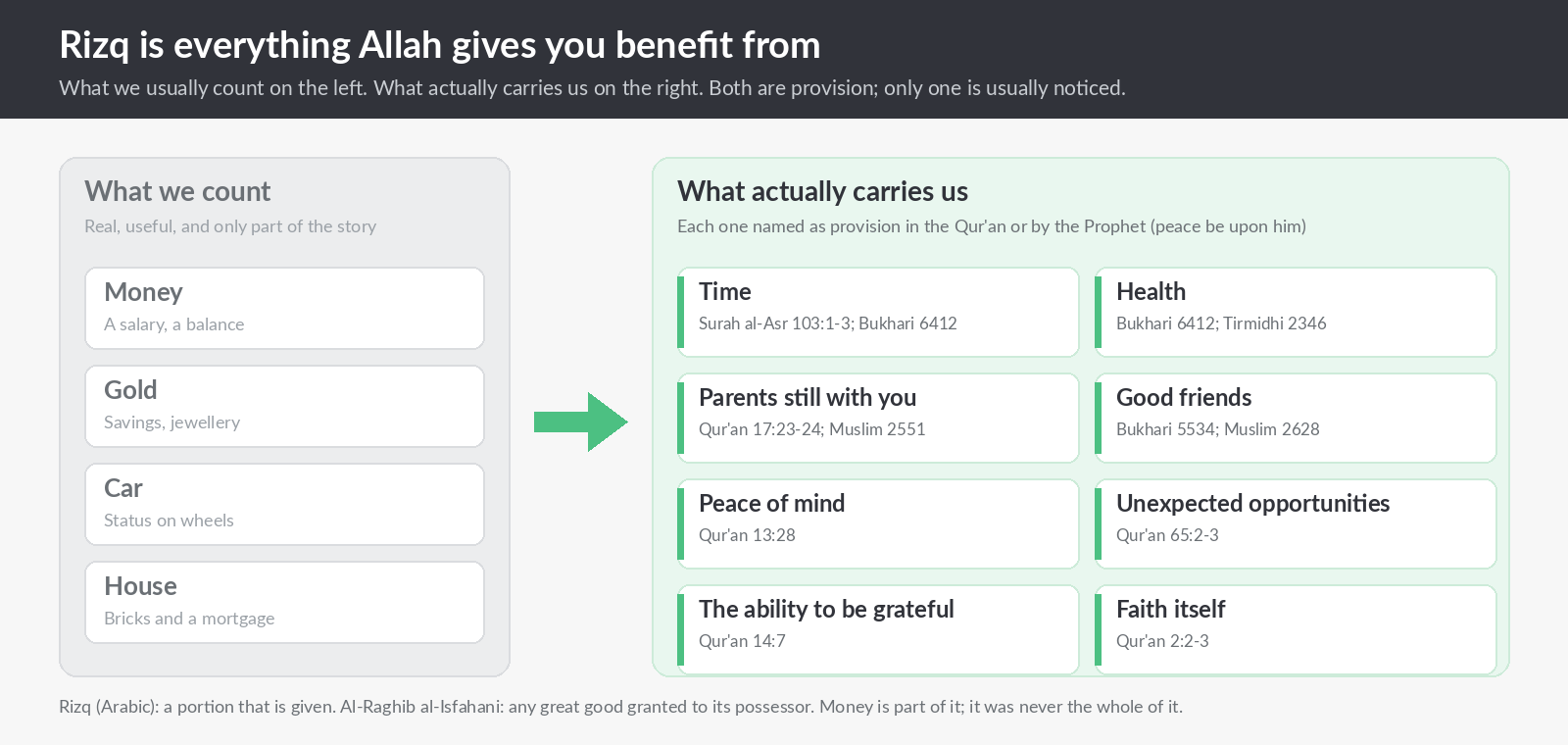
Ask most people what rizq means and they will reach for a figure: a salary, a house, a car, a balance in an account. Ask the Qur'an and the answer is wider and kinder. Rizq is everything Allah gives you benefit from: the breath in your chest this morning, the parents still in your life, the friend who tells you the truth, the hour you have free, the health that lets you stand in prayer, and the quiet heart that can say Alhamdulillah and mean it. Money is part of rizq. It was never the whole of it.
Rizq is not a bank balance
The Arabic word rizq means a portion that is given. The classical lexicographer al-Raghib al-Isfahani (d. 1108) explained that the Qur'an uses it for worldly and next-worldly blessings alike, for what feeds and clothes us, and for any great good granted to a person. When Allah says "spend from what We have provided you" (63:10), the commentators gloss "what We have provided" as wealth, knowledge and standing, not wealth alone. Al-Ghazali (d. 1111), explaining Allah's name al-Razzaq, The Provider (51:58), wrote that He created the provision, the one who is provided for, and the means of benefiting from it. Contemporary scholars put it simply: rizq includes wealth, children, a spouse, knowledge, a good appearance and sound health, whether earned or simply given.
The Prophet ﷺ taught the same thing in a sentence that should hang above every desk: "There are two blessings which many people lose: health and free time." (Sahih al-Bukhari 6412). Neither appears on a payslip. Both are rizq, and both are quietly spent every day. In another hadith he ﷺ said that whoever wakes up safe in his home, healthy in his body, with food for the day, it is as though the whole world has been gathered for him (Jami' al-Tirmidhi 2346, graded hasan). Safety, health and today's food: that is the Prophet's ﷺ definition of having everything.
Consider the forms of rizq that no income can buy:
- Time. Allah swears by it in Surah al-Asr (103:1-3) and declares that humanity is in loss except those who use it for faith, good deeds and encouraging one another. Every hour is provision with an expiry date.
- Health. The hadith of the two blessings (Bukhari 6412) lists it first. Anyone who has watched a loved one lose it knows why.
- Your parents' presence. The Qur'an pairs kindness to parents with the worship of Allah Himself (17:23-24), and the Prophet ﷺ described the person who has elderly parents and does not use that chance to earn Paradise as having lost something irreplaceable (Sahih Muslim 2551a). Parents are rizq with a time limit.
- Good friends. The Prophet ﷺ compared a good companion to a seller of musk and a bad one to a blacksmith's bellows (Bukhari 5534, Muslim 2628). A friend who pulls you toward Allah is provision in human form.
- Peace of mind. "Truly, in the remembrance of Allah do hearts find rest" (13:28). Many wealthy people would trade a great deal for a night of it.
- Opportunities. Allah promises the one who is mindful of Him provision "from where he does not expect" (65:3). The unexpected door is rizq too.
- Gratitude itself. The ability to notice and thank is a gift, and Allah has tied increase to it: "If you are grateful, I will surely increase you" (14:7).
In our working lives we measure success by titles, achievements and financial growth. Islam does not dismiss those, but it insists that real success also includes gratitude, purpose, and the privilege of being present in the moments that matter: a child's first steps, a parent's last years, a friend's hard day. Those moments are not a break from rizq. They are rizq.
Rizq is written, and effort is still commanded
Islam holds two truths together. The first: your provision is decreed. "There is no creature on earth but that its provision is upon Allah" (11:6), and "in the heaven is your provision and all you are promised" (51:22). The Prophet ﷺ said that no soul will die until it has received its provision in full, "so fear Allah and be moderate in seeking" (Sunan Ibn Majah 2144, sahih). The second truth: you are commanded to go and get it. "It is He who made the earth manageable for you, so walk among its slopes and eat of His provision" (67:15). The verse does not say wait for provision; it says walk.
"So walk among its slopes and eat of His provision; and to Him is the resurrection."Qur'an 67:15
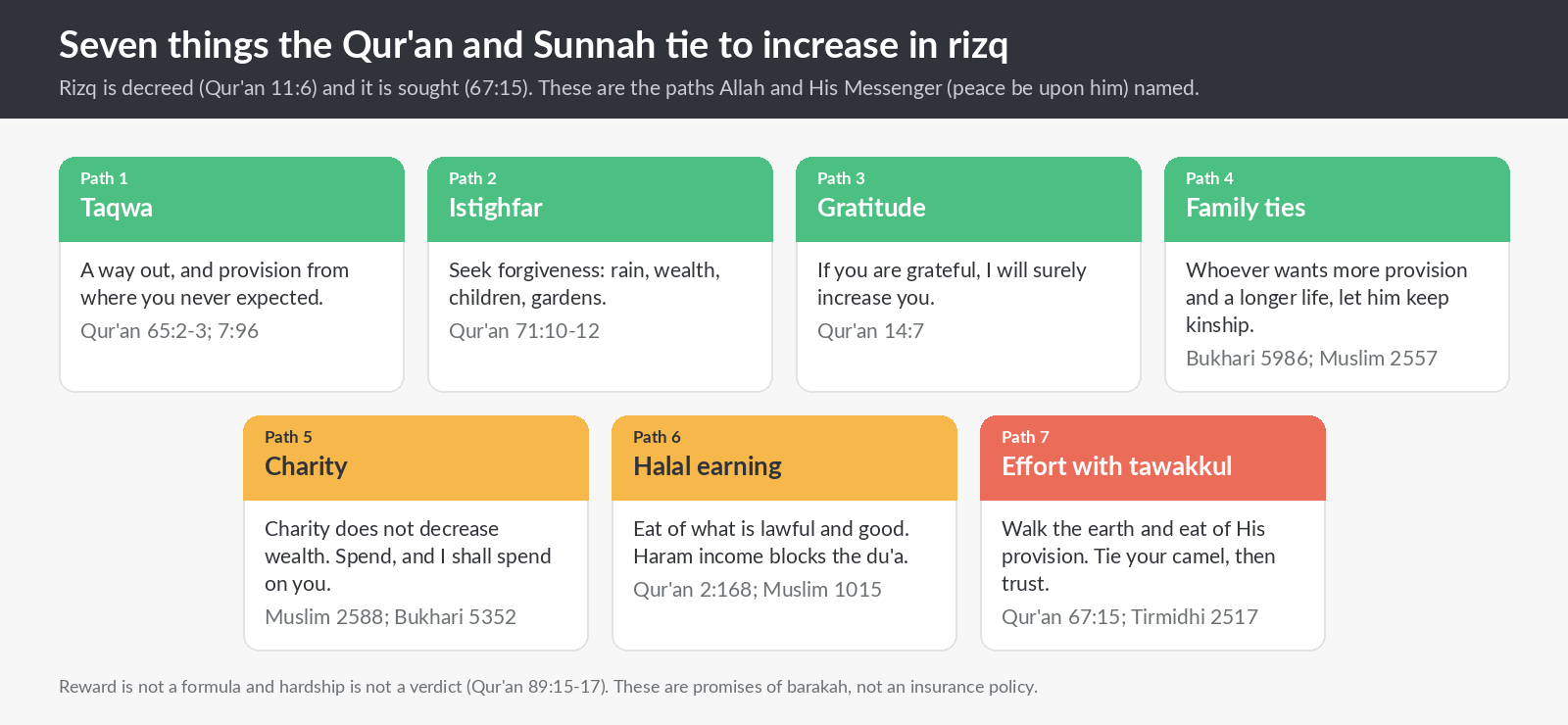
Tawakkul, trust in Allah, is not the abandonment of effort. The Prophet ﷺ told a man asking whether to tie his camel or trust in Allah: "Tie it, and trust in Allah" (Tirmidhi 2517, hasan). He also said that if we trusted Allah as we should, He would provide for us as He provides for the birds, which "go out in the morning hungry and return in the evening full" (Tirmidhi 2344, hasan sahih). Notice that the birds go out. Ibn al-Qayyim (d. 1350) put the principle precisely: the essence of tawakkul is not complete without taking the means Allah has set out, and helplessness should never be dressed up as trust. Your job is to work. Your job is to strive. Your job is to make du'a. The result is in Allah's hands.
Why life feels so expensive now
Let us be honest about the pressure. Life in Auckland, Sydney or Melbourne has become far more money-dependent than it was for our parents. A good education, which we rightly treat as essential for our children, is now a major financial commitment. Medical treatment and medicines keep rising in cost. Much of what we eat is processed and artificial, and our children are drawn to food that looks and tastes appealing but harms them, so illness and treatment become part of the household budget too. Even the basics are tied to energy and money: electricity, gas, fuel, rent or mortgage, insurance, internet. It can feel as though every important part of modern life has a price attached and a direct debit behind it.
The pressure to earn more
Social media has made this harder. We see only the slices of other people's lives that they choose to show: a new car, a beautiful kitchen, a holiday abroad, a business that appears to run itself. Looking at it long enough can convince a person that his own life is somehow less. But the life on the screen is rarely the whole reality, and the comparison it provokes creates anxiety, a sense of deprivation, and a hunger to earn more and more. The Prophet ﷺ gave the cure fourteen centuries before the first feed: "Look at those who are below you, and do not look at those above you; it is more likely to keep you from belittling Allah's favour upon you" (Sahih Muslim 2963a).
The problem is not the desire. It is the path.
There is nothing wrong with wanting to earn more or to live comfortably. Islam does not command anyone to abandon the world. Earning through halal means, providing for a family, educating children, paying for treatment and living with dignity are all legitimate, even praiseworthy. The Qur'an's instruction is not "want less"; it is "eat of what is lawful and good (halalan tayyiban) on the earth" (2:168). The problem begins when needs grow, income feels insufficient, and a person starts looking for shortcuts. That is where the line between halal and haram blurs. Bribery, deception, false invoices, unjust profit, taking what belongs to others, income from what Allah has forbidden: all of it can look like quick money. The Prophet ﷺ foresaw exactly this: "A time will come upon people when a man will not care whether what he takes is from halal or haram" (Bukhari 2059).
The question is whether such wealth brings any peace or barakah. The Prophet ﷺ described a traveller, dishevelled and dusty, raising his hands to the sky, "O Lord, O Lord", while his food, drink and clothing were from haram, and asked, "how can he be answered?" (Sahih Muslim 1015). Haram income does not only fail to bless; it blocks the du'a that was meant to bring rizq in the first place. And there is an audit at the end. The Prophet ﷺ said the feet of a servant will not move on the Day of Judgement until he is asked about his wealth, "where he earned it and on what he spent it" (Tirmidhi 2417, graded hasan sahih by al-Tirmidhi). The question will not only be "how much did you earn?" It will also be "where did you earn it from?"
Barakah: the part no one can count
Rizq has a quantity and it has a quality. The quality is barakah, which the scholars define as the establishment of divine goodness in a thing: an increase in benefit that cannot be measured by the amount. Al-Raghib traced the word to the image of a camel kneeling firmly, something settled and steady. You have seen barakah and its absence. One family lives peacefully on a modest income, the children fed, the rent paid, a little left for guests. Another household earns three times as much and the money is never enough; it drains away through things that break, bills that surprise, arguments that cost. Same city, same prices, different barakah.
So the person who wants more rizq, less financial strain, or more blessing in what he already has should not look only at worldly shortcuts. He should also look at the paths Allah and His Messenger ﷺ have laid out. They are specific.
What Allah has tied to increase
Taqwa
"Whoever is mindful of Allah, He will make a way out for him, and will provide for him from where he does not expect" (65:2-3). Rizq is not limited to our planning, spreadsheets and expectations; Allah opens doors we could never have drawn on the plan. And the promise is collective as well as personal: "If the people of the towns had believed and been mindful of Allah, We would have opened upon them blessings from the heaven and the earth" (7:96). Taqwa keeps a person on the halal path, makes him decide with Allah in view, and becomes the means by which Allah opens help from unexpected directions.
Istighfar, seeking forgiveness
The Qur'an records Prophet Nuh (peace be upon him) telling his people: "Ask forgiveness of your Lord; indeed, He is ever forgiving. He will send rain upon you in abundance, and give you increase in wealth and children, and give you gardens and rivers" (71:10-12). Istighfar is not only about wiping out sins. The Qur'an connects it directly to rain, wealth and children: the very things a worried household prays for.
Gratitude
"If you are grateful, I will surely increase you" (14:7) is as plain a promise as the Qur'an makes. Our attention naturally sits on what we lack; Allah redirects it to what we have. The Qur'an puts seeking, worship and thanks in a single breath: "So seek provision from Allah, and worship Him, and be grateful to Him" (29:17). Gratitude is not only saying Alhamdulillah with the tongue. It is recognising that each blessing is a gift and then using it the way the Giver intended: health for worship and work, time for family and good, money for what is halal.
Family ties
The Prophet ﷺ said: "Whoever would like his provision to be increased and his life to be extended, let him maintain his ties of kinship" (Bukhari 5986, Muslim 2557a). This is not merely a social virtue. The Messenger ﷺ tied it explicitly to more rizq and more life. For migrants in New Zealand and Australia, whose relatives are often a time zone and an ocean away, the phone call home is not a chore to fit in. It is an investment in provision.
Charity
Many of us think: my income is already tight, how can I afford to give? Islam answers with a principle that defies arithmetic. The Prophet ﷺ said: "Charity does not decrease wealth" (Muslim 2588). And in a hadith qudsi Allah says: "O son of Adam, spend, and I shall spend on you" (Bukhari 5352, Muslim 993a). The Qur'an gives the picture: a single grain that grows seven ears, each with a hundred grains (2:261). On paper, giving money away reduces what you have. In reality, wealth given for Allah is never lost; it returns as barakah, and it "extinguishes sin as water extinguishes fire" (Tirmidhi 614, hasan). The very thing a person clutches because he fears losing it is the thing Allah tells him to release in order to receive.
Putting the Hereafter first
The Prophet ﷺ said that whoever makes the Hereafter his concern, Allah settles his affairs for him, places richness in his heart, and the world comes to him humbled; and whoever makes the world his concern, Allah scatters his affairs, places poverty before his eyes, and he gets of the world only what was written for him anyway (Ibn Majah 4105, sahih). Read that last clause again. He gets only what was written anyway. The chase added nothing except the anxiety.
Two people, two kinds of reliance
Imagine two people with exactly the same income. Both know hard times can come, so both decide to save. The first thinks: "If a crisis comes, my savings will save me." He saves more and more, holds his money tightly, and slowly his reliance on his accumulated wealth grows stronger than his reliance on Allah. The second also saves, also plans, also takes financial responsibility seriously. But his thinking is different: "I need to save, but my ultimate support is not this money. If a difficulty is coming, it comes by Allah's will, and Allah can also remove it." So after meeting his responsibilities he gives some of what he has to those in need: a contribution to someone's treatment, groceries for a struggling family, a quiet gift for Allah's sake.

Both have savings. The support of their hearts is different. One says: "My wealth will save me in difficult times." The other says: "My wealth is a means available to me; my Protector is Allah." That is the difference between tawakkul and trusting in wealth. Years pass. Perhaps the first man falls seriously ill, and his savings genuinely help pay for treatment; his planning serves him well. Perhaps the second faces difficulties too but is spared a crisis of that size, and he wonders whether his charity and his trust had already smoothed roads he never saw. Here an important caution: we cannot say that a particular illness is the result of someone's deeds, and we cannot promise that charity guarantees a life without hardship. The Qur'an warns against reading provision as a verdict: when Allah gives a person plenty, he says "my Lord has honoured me", and when He restricts his provision, he says "my Lord has humiliated me". "No!" the Qur'an replies (89:15-17). The real lesson is about where the heart rests. Use wealth as a means; never make it your security.
Earn more, but earn it the right way
If we want to earn more, then by all means, let us work harder: build a better future for our children, spend on their education and health, improve our homes, give our families a dignified life. But never let the desire for more erase the line between halal and haram. The cost of living cannot become an excuse to forget it. Our needs have grown; Allah's commands have not changed. And the measure of success was set by the Prophet ﷺ long ago: "Richness is not in having many possessions; richness is the richness of the soul" (Bukhari 6446, Muslim 1051).
The real recipe for abundant rizq
- Make du'a for rizq, and pair the du'a with hard work.
- Try to earn more, and earn it through halal means only.
- Seek forgiveness, especially when things are tight.
- Be grateful for what you have, in word and in use.
- Make decisions with taqwa: as if Allah is watching, because He is.
- Maintain your family ties, across whatever distance.
- Give charity and spend in the way of Allah, even from a little.
- Believe that rizq comes through effort and planning, but its Owner is Allah.
Perhaps true success is not having more than everyone else. Perhaps it is that whatever we have is halal, that there is barakah in it, that our hearts are at peace, and that we remember we will one day answer for how we earned it and how we spent it. That may be the real recipe for abundant rizq.
A du'a for halal and sufficient rizq
اللَّهُمَّ اكْفِنِي بِحَلَالِكَ عَنْ حَرَامِكَ وَأَغْنِنِي بِفَضْلِكَ عَمَّنْ سِوَاكَ
Allahumma-kfini bi-halalika 'an haramika, wa aghnini bi-fadlika 'amman siwak.
"O Allah, suffice me with what You have made lawful so that I need not what You have forbidden, and enrich me by Your bounty so that I need none besides You."
Jami' al-Tirmidhi 3563, graded hasan. The Prophet ﷺ taught it as a du'a that would pay off a debt even the size of a mountain.
Frequently asked
Is it un-Islamic to want to be wealthy?
No. Wanting halal wealth to provide for family, give charity and live with dignity is legitimate; several of the Companions were wealthy. What Islam forbids is haram earning, neglecting the rights of Allah and people in the chase, and letting wealth become the thing your heart relies on.
If my rizq is already written, why should I work hard?
Because the same Allah who wrote it commanded you to walk the earth and seek it (67:15), and the Prophet ﷺ told the man to tie his camel. Effort is part of how the decree reaches you. What is lifted from you is the anxiety, not the work: you do your part and leave the outcome to Him.
I am on a low income or a benefit. Is that a sign Allah is displeased with me?
No. The Qur'an explicitly rejects the idea that plenty means honour and restriction means humiliation (89:15-17). Provision is a test in both directions. Many of the Prophet's ﷺ beloved Companions lived in poverty and are in Paradise. What matters is halal, gratitude and effort within your means.
Does giving charity guarantee I will not face hardship?
No. Charity brings barakah, expiates sins and invites Allah's help, but hardship is part of every believer's life, including the Prophets'. We give because Allah commanded it and promised to replace it, not as an insurance policy.
Where does my KiwiSaver or superannuation fit in?
Retirement savings are a legitimate means of planning, as long as the money is invested in halal sectors. We cover how to check that in Is Your Super or KiwiSaver Halal?
Sources
- Qur'an 67:15, 65:2-3, 71:10-12, 14:7, 7:96, 51:22, 51:58, 11:6, 2:168, 2:261, 13:28, 17:23-24, 29:17, 63:10, 89:15-17, 103:1-3. quran.com.
- Sahih al-Bukhari 6412 (two blessings), 5986 (kinship), 5352 (spend and I shall spend), 2059 (halal or haram), 5534 (companions), 6446 (richness of the soul). sunnah.com.
- Sahih Muslim 2588 (charity), 993a, 2963a (look at those below you), 2551a (parents), 2628, 1015 (haram food and du'a), 1051, 2557a. sunnah.com.
- Jami' al-Tirmidhi 2346 (safe, healthy, fed), 2344 (the birds), 2517 (tie your camel), 2417 (four questions), 614 (charity extinguishes sin), 3563 (the du'a), with gradings. sunnah.com.
- Sunan Ibn Majah 2144 (be moderate in seeking), 4105 (the Hereafter as one's concern). sunnah.com.
- The meaning of rizq in the Qur'an and Sunnah (al-Raghib al-Isfahani, al-Halabi), SeekersGuidance. Link; Islam Q&A 194503 on what rizq includes. Link.
- The meaning and causes of barakah, Islam Q&A 266249 and 145514. Link, Link.
- Tawakkul and taking the means: Ibn al-Qayyim, Zad al-Ma'ad 4/15, and Ibn Baz, via Islam Q&A 130499 and 2438. Link, Link.
Religious reflection and general information, not financial advice. For decisions about debt, investment or benefits, speak to a qualified scholar and a licensed adviser.
Have a question of your own?
Ask the Guiding Light Islamic GPT, or contact us for complex personal matters.
Ask a question