Faith · Knowledge · Philosophy
From Information to Baseerah: An Islamic Perspective with Iqbal and Rumi

A teenager in Auckland can ask an AI to summarise every book on the Prophet's life before her tea goes cold. A retired engineer in Melbourne can watch three lectures on quantum physics before breakfast. Never has a generation held so much information in its hands. And yet many of us feel less sure, less settled and less wise than our grandparents, who owned perhaps a dozen books. The Qur'an names the problem with startling precision: "It is not eyes that are blinded, but blinded are the hearts which are within the breasts" (al-Hajj 22:46). This article is about the road from the eyes to the heart: from information to baseerah.
A ladder, not a pile
Modern information science describes a well-known pyramid: data becomes information, information becomes knowledge, and knowledge becomes wisdom. The systems thinker Russell Ackoff set it out in a 1989 paper, "From data to wisdom", and it has shaped how companies, universities and now AI developers think about knowing. It is a useful picture. But it stops at the top of the pyramid, as if wisdom were the last word.
The Islamic tradition keeps climbing. It sees knowing as a ladder with five rungs, and the upper rungs are not reached by collecting more of what is on the lower ones:
- Information (khabar): reports and facts that reach us from outside.
- Knowledge ('ilm): information understood, connected and put to use.
- Wisdom (hikmah): what emerges when information and knowledge are joined with observation and reflection.
- Baseerah (basirah): insight of the heart, the inner sight that sees things as signs and sees the self honestly.
- Wijdan: inner finding, the truth that is not only known or seen but lived and tasted.
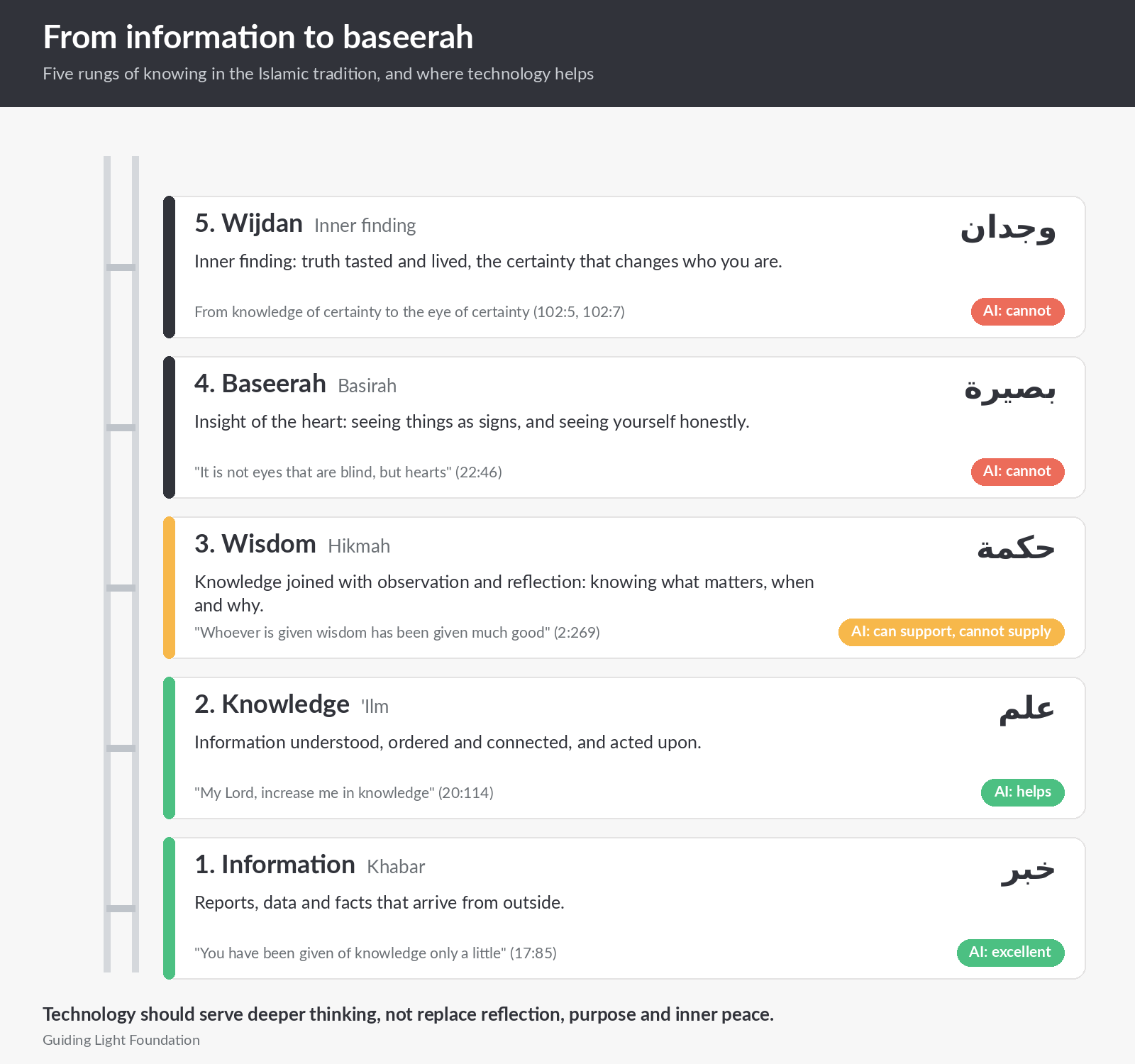
The point of the ladder is not to look down on information. Islam began with the command "Read" (al-'Alaq 96:1), and the Prophet ﷺ was told to pray, "My Lord, increase me in knowledge" (Ta Ha 20:114). The point is that each rung asks something different of us, and a life spent only on the first rung, however full of facts, can leave the heart untouched.
Rung one: information
Information is what we receive: a news report, a statistic, a hadith we have heard quoted, the summary an AI gives us. It is necessary and it is never enough. Muhammad Iqbal (d. 1938), the poet-philosopher of South Asia, put it in one line of Urdu:
خرد کے پاس خبر کے سوا کچھ اور نہیں
ترا علاج نظر کے سوا کچھ اور نہیں
Khirad ke paas khabar ke siva kuchh aur nahin / tira ilaj nazar ke siva kuchh aur nahin
"The intellect has nothing but information; your cure is nothing but vision."Muhammad Iqbal, Bal-e-Jibril (1935). Translation ours.
Khabar is report, news, information; nazar is sight, vision, a way of seeing. Iqbal is not dismissing the intellect: elsewhere he devoted whole lectures to defending reason. He is saying that information alone cannot heal us. The Qur'an adds a note of humility for anyone who thinks a full archive is the same as understanding: "You have not been given of knowledge except a little" (al-Isra' 17:85).
Rung two: knowledge
Knowledge ('ilm) is information that has been understood, ordered and connected, so that it can guide action. The Qur'an honours it: "Allah will raise those who have believed among you and those who were given knowledge, by degrees" (al-Mujadilah 58:11). But the Prophet ﷺ also taught us to fear a particular kind of knowledge. Among his supplications was: "O Allah, I seek refuge in Thee from the knowledge which does not benefit, from the heart that does not entertain the fear (of Allah), from the soul that does not feel contented and the supplication that is not responded" (Sahih Muslim 2722).
What makes knowledge beneficial? Jalal al-Din Rumi (d. 1273) answered in a famous passage of his Masnavi:
"When knowledge strikes on the heart, it becomes a helper; when knowledge strikes on the body, it becomes a burden. God hath said, '(Like an ass) laden with his books': burdensome is the knowledge that is not from Himself."Rumi, Masnavi I:3447 to 3448, translated by R. A. Nicholson
Rumi is echoing the Qur'an's image of people who carry scripture without living it, "like that of a donkey who carries volumes [of books]" (al-Jumu'ah 62:5). Knowledge that stays in the head, or in our devices, is weight. Knowledge that reaches the heart is a companion.
Imam al-Ghazali (d. 1111) made the same distinction from his own crisis of doubt. In his autobiography, al-Munqidh min al-Dalal, he wrote that "what a difference there is between knowing the definition of health and satiety... and being healthy and satisfied!" A sober person can define drunkenness perfectly and not be drunk at all. Definitions are knowledge. Being changed is something else.
Rung three: wisdom, when knowledge meets observation
Wisdom (hikmah) is what happens when information and knowledge are brought into contact with careful observation and honest reflection. The Qur'an treats it as a gift beyond price: "He gives wisdom to whom He wills, and whoever has been given wisdom has certainly been given much good. And none will remember except those of understanding" (al-Baqarah 2:269).
Strikingly, the Qur'an does not ask us to find wisdom by closing our eyes. It asks us to open them. "Do they not look at the camels, how they are created? And at the sky, how it is raised? And at the mountains, how they are erected? And at the earth, how it is spread out?" (al-Ghashiyah 88:17 to 20). The people of understanding are those "who remember Allah while standing or sitting or lying on their sides, and give thought to the creation of the heavens and the earth, saying: Our Lord, You did not create this aimlessly" (Al 'Imran 3:190 to 191). And Allah promises: "We will show them Our signs in the horizons and within themselves until it becomes clear to them that it is the truth" (Fussilat 41:53).
Iqbal saw in this the root of science itself. In the first lecture of The Reconstruction of Religious Thought in Islam he spoke of "the general empirical attitude of the Qur'an which engendered in its followers a feeling of reverence for the actual and ultimately made them the founders of modern science." In the fifth lecture he wrote simply: "Knowledge must begin with the concrete." Wisdom is not a retreat from the world. It is knowledge that has looked hard at the world, and at the self, and asked what it all means.
Iqbal described two ways of connecting with reality: "reflective observation and control of its symbols as they reveal themselves to sense-perception", and "direct association with that reality as it reveals itself within." The first is the way of the scientist and the scholar. The second leads to the next rung.
Rung four: baseerah, the sight of the heart
Arabic has two words for seeing. Basar is the sight of the eye. Basirah is, in Lane's classic lexicon, "mental perception; the perceptive faculty of the mind... knowledge", and Lane records the saying that "blindness of the eyes is a lighter thing than blindness of the perceptive faculties of the mind." The Prophet ﷺ was commanded to say: "This is my way; I invite to Allah with insight ('ala basiratin), I and those who follow me" (Yusuf 12:108). Revelation itself is described as basa'ir, "enlightenment from your Lord. So whoever will see does so for the benefit of his soul, and whoever is blind does harm against it" (al-An'am 6:104).
Iqbal located this sight in the heart. The Qur'an, he wrote, insists that "sense-perception must be supplemented by the perception of what the Qur'an describes as Fu'ad or Qalb, i.e. heart":
"The 'heart' is a kind of inner intuition or insight which, in the beautiful words of Rumi, feeds on the rays of the sun and brings us into contact with aspects of Reality other than those open to sense-perception. It is, according to the Qur'an, something which 'sees', and its reports, if properly interpreted, are never false. We must not, however, regard it as a mysterious special faculty."Muhammad Iqbal, The Reconstruction of Religious Thought in Islam, Lecture I
Two phrases matter here. "If properly interpreted": baseerah is not permission to trust every feeling. And "not a mysterious special faculty": it is the heart doing what hearts were made to do once they are cleaned and attentive. Iqbal was emphatic that this inner sight does not compete with reason: "Nor is there any reason to suppose that thought and intuition are essentially opposed to each other. They spring up from the same root and complement each other. The one grasps Reality piecemeal, the other grasps it in its wholeness."
Rumi's parable of the elephant in the dark shows what baseerah adds. Some people bring an elephant into a dark house, and visitors feel it with their hands. The one who touches the trunk says it is a water pipe; the one who touches the ear says it is a fan; the leg is a pillar, the back a throne. Rumi concludes:
"If there had been a candle in each one's hand, the difference would have gone out of their words. The eye of sense-perception is only like the palm of the hand: the palm hath not power to reach the whole of him."Rumi, Masnavi III:1268 to 1269, translated by R. A. Nicholson
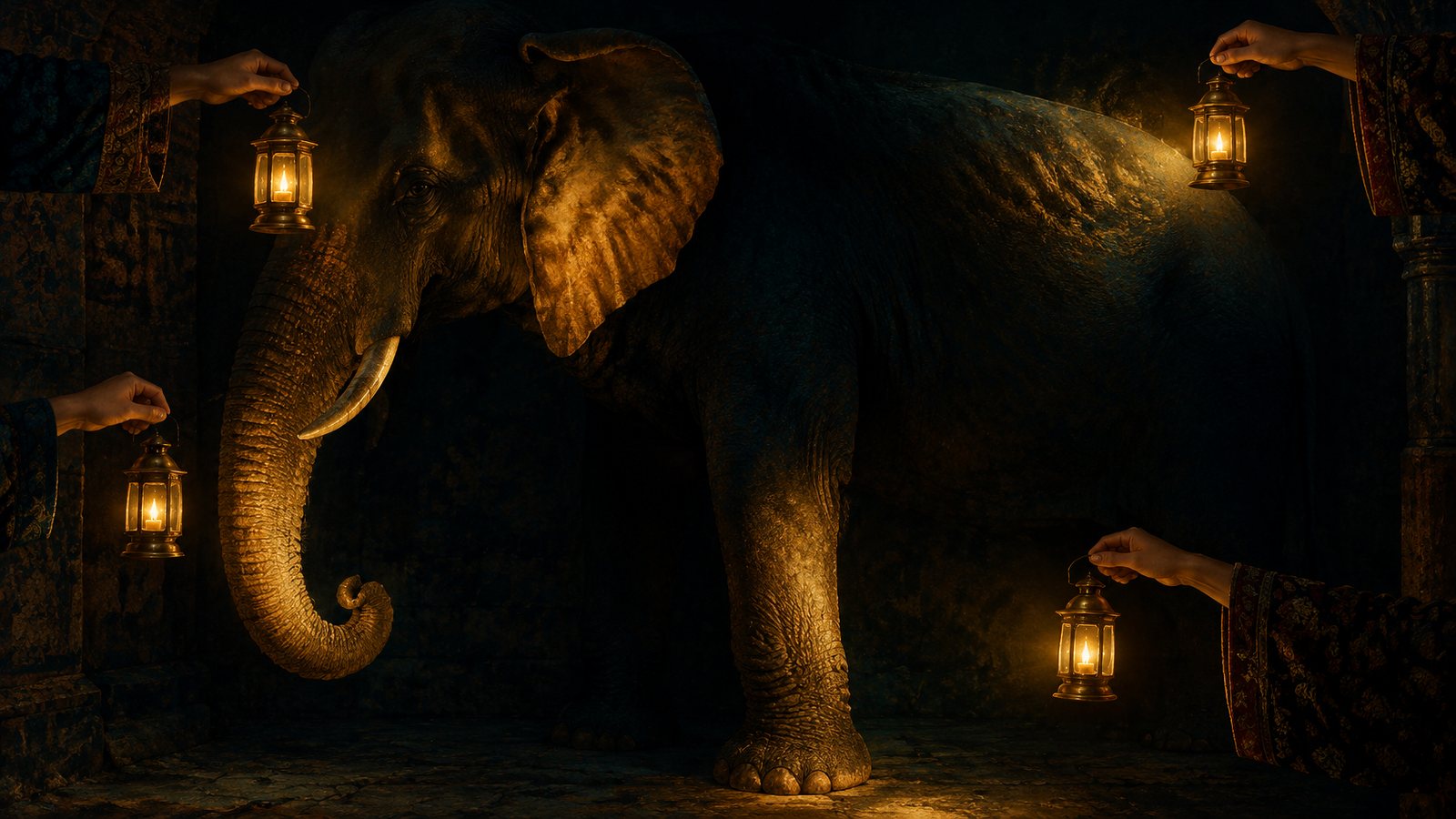
This is our age exactly. We each hold a palm-sized screen that touches one part of reality very precisely. Baseerah is the candle that lets us see the whole, including the part of the picture that is us. The Qur'an even uses the word for our inner self-knowledge on the Day of Judgement: "Rather, man, against himself, will be a witness (basirah)" (al-Qiyamah 75:14). The heart that sees clearly cannot hide from itself.
Scholars of the heart often recall a short supplication, "O Allah, show me things as they truly are." It is beautiful, but it is not established as a saying of the Prophet ﷺ: Ibn al-Jawzi mentions it only as a report from the early generations. We can make the meaning our own prayer without attributing the words to him.
Rung five: wijdan, truth that is lived
The root of wijdan (و ج د) means to find. Lane defines it as "he found it... perceived it; saw it; experienced it", and notes that such finding can be through the senses or "by the intellect, of which kind is one's knowing God." The early masters of the inward life used the related words wajd and wujud. Al-Hujwiri (d. c. 1072) explained that wujud means "finding" and is "a grace bestowed by the Beloved on the lover." We use wijdan here for the top of the ladder: truth that has been found within and now shapes who we are.
The Qur'an itself describes degrees of certainty that map onto this climb. There is "knowledge of certainty" ('ilm al-yaqin, al-Takathur 102:5), then "the eye of certainty" ('ayn al-yaqin, 102:7), and finally "the truth of certainty" (haqq al-yaqin, al-Waqi'ah 56:95 and al-Haqqah 69:51). Scholars have long explained it with fire: to be told that fire burns is knowledge; to see a fire is the eye of certainty; to feel its heat is the truth of certainty. Al-Ghazali drew the same three degrees: certainty by demonstration is 'ilm, acceptance from hearsay and trial is faith, and "actual acquaintance with that state is immediate experience (dhawq)", literally tasting.
Iqbal named the goal in one sentence near the end of the Reconstruction: "The ultimate aim of the ego is not to see something, but to be something." Wijdan is not a vision we collect. It is the believer becoming what they have understood: patient because they have tasted that Allah is with the patient, generous because they have found that what is given is not lost, at peace because the heart has found its rest.
Where AI fits: excellent servant, poor master
Artificial intelligence is extraordinary at the first two rungs. It can gather, sort and summarise information faster than any human, and its summaries can look very much like knowledge. Our own Islamic GPT on this website is built to do exactly that: to point people quickly to the Qur'an, the Sunnah and the positions of the scholars. Used well, it frees time for reflection that we would otherwise spend searching.
But early research is a gentle warning. In a 2025 study by Microsoft Research and Carnegie Mellon University of 319 knowledge workers, people who placed more confidence in generative AI reported doing less critical thinking, while people with more confidence in their own abilities reported more. A small 2025 MIT Media Lab experiment, still a preprint, found that participants who wrote essays with an AI chatbot showed the weakest brain connectivity of the groups studied and struggled to quote their own work. A survey study of 666 people found that frequent AI use was linked with lower critical thinking scores, largely through "cognitive offloading". None of these studies proves that AI makes people think less, and each has limits. But together they describe a risk that the Islamic ladder predicts: if a machine climbs the lower rungs for us, we may never start climbing ourselves.
A machine has no heart to purify, no self to witness against, no Day of Judgement, no taste of certainty. It cannot reach baseerah or wijdan, and it cannot carry us there. So the principle is simple:
Some practical habits help:
- Think first, then ask. Write down your own understanding of a question before you ask a machine, and compare.
- Verify the sources. Treat any AI answer about the deen as information to be checked against the Qur'an, authentic hadith and qualified scholars, never as a fatwa.
- Keep a screen-free hour. Reflection (tafakkur) needs silence. The Qur'an's people of understanding think while "standing, sitting and lying on their sides", not while scrolling.
- Turn knowledge into action. Rumi's helper is the knowledge that strikes the heart. Choose one thing you learned this week and live it.
Quantum physics and metaphysics: what the new science does and does not say
Quantum physics is often dragged into spiritual talk, so we should be careful. In quantum theory, the equations that describe a system routinely predict combinations ("superpositions") of very different states, yet every measurement gives a single definite result. Physicists call the puzzle of how to reconcile these "the measurement problem". It is a real and deep problem. But it does not mean that human consciousness creates reality: as the Stanford Encyclopedia of Philosophy notes, "none of the mainstream approaches accord any special physical role to conscious observers." Claims that quantum physics "proves" the soul or the power of positive thinking are not science.
What modern physics does offer is humility about observation. Niels Bohr stressed that "the account of all evidence must be expressed in classical terms", in the language of the instruments and the observers. Iqbal, lecturing in the late 1920s, drew the philosophical lesson. "Physics, as an empirical science, deals with the facts of experience, i.e. sense-experience. The physicist begins and ends with sensible phenomena," he wrote, and of Einstein's revolution: "Einstein's theory, which, as a scientific theory, deals only with the structure of things, throws no light on the ultimate nature of things which possess that structure." He quoted the astronomer Arthur Eddington: "the entities of physics can from their very nature form only a partial aspect of the reality."
This is where metaphysics, the study of what lies behind and beyond the measurable, meets the Qur'an. Allah is "Knower of the unseen and the witnessed" ('alim al-ghaybi wa al-shahadah, al-Hashr 59:22). Science is a magnificent way of studying the witnessed world, the first two or three rungs of our ladder. Baseerah is the faculty that reads that witnessed world as ayat, signs pointing to the unseen. The two are not rivals. The physicist measuring an electron and the believer reflecting on the order that makes measurement possible are both obeying the command to look. Only one of them, though, is asking what it all means for the life of their soul.

Climbing the ladder this week
Rumi left us a line that could stand over every search box: "Thou hast pronounced the name: go, seek the thing named. Know that the moon is on high, not in the water of the stream" (Masnavi I:3457, Nicholson). Information gives us the name. The ladder is how we seek the thing named. A simple plan:
- Information: choose one short passage of the Qur'an, such as Al 'Imran 3:190 to 191, and read a reliable translation.
- Knowledge: read a trusted tafsir of it, and note one thing you did not know.
- Wisdom: spend ten minutes outside, at night if you can, looking at the sky as the verse asks, with your phone away.
- Baseerah: ask honestly what in your own life the passage is speaking to, and write one sentence.
- Wijdan: act on that sentence, and ask Allah to let you taste its truth.
The Qur'an promises that this path is opened by Allah, not by our cleverness: "If you fear Allah, He will grant you a criterion" (al-Anfal 8:29). And so we end where the Prophet ﷺ began, with the two prayers that frame the whole ladder: "My Lord, increase me in knowledge" (20:114), and "O Allah, I seek refuge in You from knowledge that does not benefit" (Muslim 2722).
Frequently asked
What is the difference between basar and baseerah?
Basar is physical sight, the work of the eyes. Baseerah is the perception of the heart and mind: understanding, insight and moral clarity. The Qur'an points to the difference when it says that "it is not eyes that are blinded, but blinded are the hearts" (22:46).
Is it wrong to use AI to learn about Islam?
No. AI is a tool, and tools can serve good ends. It can help you find verses, hadith and scholarly positions quickly. But treat its answers as information to be checked, not as rulings, and take personal religious questions to a qualified scholar. Use the time it saves you for reflection and practice.
Does quantum physics prove the existence of God or the soul?
No, and it does not disprove them either. Quantum physics describes how the measurable world behaves. Mainstream interpretations do not give consciousness a special physical role. What physics does show is the limit of what measurement can tell us, which leaves room for the questions of meaning and purpose that the Qur'an addresses.
How can I develop baseerah?
The scholars point to the same steps the ladder describes: learn sound knowledge, reflect on the Qur'an and on creation, remember Allah often, purify your intentions and avoid what darkens the heart. Baseerah is a gift from Allah, and the Qur'an ties it to taqwa: "If you fear Allah, He will grant you a criterion" (8:29).
Sources
- The Qur'an: 2:269, 3:190 to 191, 6:104, 8:29, 12:108, 17:85, 20:114, 22:46, 41:53, 56:95, 58:11, 59:22, 62:5, 69:51, 75:14, 88:17 to 20, 96:1, 102:5 and 102:7. Translations follow Saheeh International. Quran.com.
- Sahih Muslim 2722, the Prophet's refuge from knowledge that does not benefit. Sunnah.com.
- Muhammad Iqbal, The Reconstruction of Religious Thought in Islam, Lectures I, II, V and VII (Iqbal Academy Pakistan text). Lecture I; Lecture V; Lecture VII; Lecture II in the Iqbal Cyber Library edition.
- Muhammad Iqbal, "Khirad ke paas khabar ke siva kuchh aur nahin", Bal-e-Jibril. Rekhta. English translation ours.
- Jalal al-Din Rumi, The Mathnawi, translated by R. A. Nicholson: I:3447 to 3448 and I:3457; III:1259 to 1270. Masnavi.net; Nicholson scan.
- Al-Ghazali, al-Munqidh min al-Dalal, in W. Montgomery Watt, The Faith and Practice of al-Ghazali. Ghazali.org.
- E. W. Lane, Arabic-English Lexicon, entries basirah and wajada. basirah; wajada.
- Al-Hujwiri, Kashf al-Mahjub, translated by R. A. Nicholson (1911), chapter on wajd and wujud. Archive.org.
- Islamweb fatwa 193117 on the status of "show me things as they are". Islamweb.
- R. L. Ackoff, "From data to wisdom", Journal of Applied Systems Analysis 16 (1989): 3 to 9.
- W. Myrvold, "Philosophical Issues in Quantum Theory", Stanford Encyclopedia of Philosophy. SEP; "Copenhagen Interpretation of Quantum Mechanics". SEP.
- H.-P. Lee et al., "The Impact of Generative AI on Critical Thinking", CHI 2025 (Microsoft Research and Carnegie Mellon University). Microsoft Research.
- N. Kosmyna et al., "Your Brain on ChatGPT", MIT Media Lab, arXiv preprint 2506.08872 (2025). arXiv.
- M. Gerlich, "AI Tools in Society: Impacts on Cognitive Offloading and the Future of Critical Thinking", Societies 15(1):6 (2025). MDPI.
General religious and philosophical reflection. For personal questions of belief or practice, please speak with a qualified scholar.
Have a question of your own?
Ask the Guiding Light Islamic GPT, or contact us for complex personal matters.
Ask a question