Money · Fiqh · Retirement
Is Your Super or KiwiSaver Halal? Shariah-Compliant Funds, Purification and Zakat

Every payslip in Australia carries a 12 per cent superannuation contribution, and most New Zealand employees are enrolled in KiwiSaver the day they start work. You cannot opt out of the system. So the question is not whether to have a retirement fund, but where that money is invested. In Islam the money in your super or KiwiSaver is yours, and you answer for what it is used for: it must not be earning from interest, alcohol, gambling, pork or the other prohibited trades, and it should be working in real, permissible economic activity. That is the first duty; everything else in this article follows from it.
Can a Muslim hold super or KiwiSaver at all?
Yes, and the reasoning is consistent across schools. Hanafi muftis of the Darul Iftaa network, answering Australian questioners directly, treat the employer's compulsory contribution as a gift from the employer to the employee, so receiving it is permissible and the profit that is earned halal is halal. The Assembly of Muslim Jurists of America (AMJA), answering the same question about the US 401(k), which works the same way, said that "most of the scholars would allow you to take part in such plans and purify your money from the haram portion when you start to receive it", so as not to lose the employer's contribution. Where an Islamic investment option is offered, AMJA says to choose it.
There is a stricter minority view, found among some Shafi'i and Hanafi scholars, that purification "is of no consequence when the underlying investment is void", and that participation is tolerated only as a necessity. We state it because it is sincerely held. The mainstream position is clear, and it has an order to it: hold the fund; direct it into a Shariah-compliant option, which in both countries is possible; and only where that is impossible, fall back on purification. Choosing a compliant fund is not an optional extra for the especially pious. It is how you discharge the duty, because leaving your money in a conventional balanced fund means knowingly earning from interest and from industries the Qur'an forbids.
"Most of the scholars would allow you to take part in such plans and purify your money from the haram portion when you start to receive it."AMJA, fatwa on investment in 401(k) plans
What "Shariah-compliant" means: the screens
The duty begins with the texts. "O mankind, eat from what is on the earth lawful and good" (Qur'an 2:168), and "Allah has permitted trade and forbidden riba" (2:275). The Prophet (peace be upon him) said that Allah is pure and accepts only what is pure, and warned that a body nourished on what is unlawful has no place in Paradise. Classical and contemporary scholars draw from this that a Muslim is responsible for the source of every dirham of income, including returns on money invested in his or her name. Your super fund invests on your behalf; what it earns is your earning. AMJA, the Darul Iftaa muftis and the Shariah boards of the Islamic funds all build on this: the first obligation is to direct the money into permissible investments, not to earn from the impermissible and clean up afterwards.
A conventional super or KiwiSaver fund invests in whatever earns a return: bank shares, government and corporate bonds (interest), brewers, casinos, supermarkets that sell pork and alcohol, defence contractors. An Islamic fund applies two layers of screening, usually to the standards of the Accounting and Auditing Organisation for Islamic Financial Institutions (AAOIFI), overseen by a Shariah board that audits the portfolio.
Forbidden (haram) sectors, excluded outright
- Conventional financial services (riba): interest-based banks, conventional insurers, lenders, and interest-bearing bonds and term deposits.
- Alcohol and tobacco: producers, wholesalers and retailers of alcohol, tobacco and other intoxicants or harmful substances.
- Gambling and speculation: casinos, betting and gaming companies, lottery operators, and highly speculative derivatives trading.
- Pork and non-halal food production: farming, processing or selling pig products and non-halal meat.
- Adult entertainment: pornography, and media or cinema businesses whose content runs against Islamic morals.
- Weapons and defence: manufacturers of arms and military contractors (excluded by most Shariah boards).
Permissible (halal) assets, where the money should be working
- Screened equities: shares in productive, ethical businesses such as healthcare, technology, telecommunications, infrastructure, construction, manufacturing and renewable energy, after passing the financial tests below.
- Property and real estate: commercial and residential property held directly or through Islamic structures (ijarah leasing, musharakah co-ownership), never through interest-bearing mortgages.
- Sukuk: asset-backed Islamic certificates that pay a share of the profit from a real asset, in place of interest-paying bonds.
- Precious metals and commodities: gold and other tangible goods, held directly or through screened funds.
- Cash held in non-interest accounts or Islamic deposit arrangements.
The financial tests
Even a company in a permitted industry is excluded if its finances lean on riba. Under the AAOIFI screens as applied by Islamic funds and screening services, a company must have interest-bearing debt below about 30 per cent of its market value, interest-bearing cash and securities below about 30 per cent, and income from impermissible activities below 5 per cent of revenue, with that small residue purified by donation. Other index providers use similar thresholds of around 33 per cent. The Shariah board publishes the methodology and audits the fund against it, which is what you should ask any fund to show you.
One warning: a fund's "ethical" or "sustainable" option is not Shariah-compliant. Those options typically exclude tobacco and weapons but still hold banks, insurers, bonds and alcohol. Only an option with a named Shariah board and a published screening methodology qualifies.
Halal superannuation in Australia: your Shariah-compliant options in 2026
Australia has had Islamic super for over a decade, but the landscape has shifted recently, so check your fund today:
- Salaam Superannuation. The members of Crescent Wealth, the first Islamic super fund, were transferred on 1 June 2024 to the Salaam Superannuation division of the Russell Investments Master Trust. It invests to AAOIFI Shariah standards with an independent Shariah board (Dar Al Shariah) and is open to any employee: you can nominate it to your employer on the standard super choice form.
- Hejaz Islamic Super and Pension is closing. Its trustee, Equity Trustees, is exiting the superannuation business. Hejaz Islamic Super stopped accepting contributions and transfers on 30 September 2026, and members' money had already been moved to cash in June. According to the closure timeline Salaam has summarised for affected members, a first payment to each member's new fund was due around 10 October 2026, with the remaining balance expected by the end of February 2027. Around 2,600 members need to choose a new fund and give its details to their employer. If you are one of them, check the Hejaz member portal for your own figures, and do not let your contributions default into a non-compliant MySuper product.
Choosing a certified fund is the simplest way to be sure. If your employer's default fund is a conventional one, you have a legal right to choose your own fund in almost all cases; the form takes five minutes. Before you sign, ask the fund three questions: who is on its Shariah board, which screening standard it follows (AAOIFI or equivalent), and when its last Shariah audit was published.
Halal KiwiSaver in New Zealand: one Shariah-compliant scheme
New Zealand's option is the AE KiwiSaver Plan, formerly the Amanah KiwiSaver Plan. Its statement of investment policy follows an AAOIFI-based mandate that excludes interest-bearing instruments, alcohol, gambling, weapons and conventional financial services, and its approval by the Ulama Council of the Federation of Islamic Associations of New Zealand (FIANZ) has been reported publicly. It is the only Shariah-compliant KiwiSaver scheme we could find. Switching is done online in a few minutes through your IRD login or the provider's form, and your employer's contributions follow you.
Two cautions. First, the scheme's fees and returns should be compared like any other; "halal" does not mean "ignore the numbers". Second, if you are new to New Zealand and were auto-enrolled, you were placed in a default scheme that will not be Shariah-compliant; check and switch.
Only if you truly cannot switch: purification
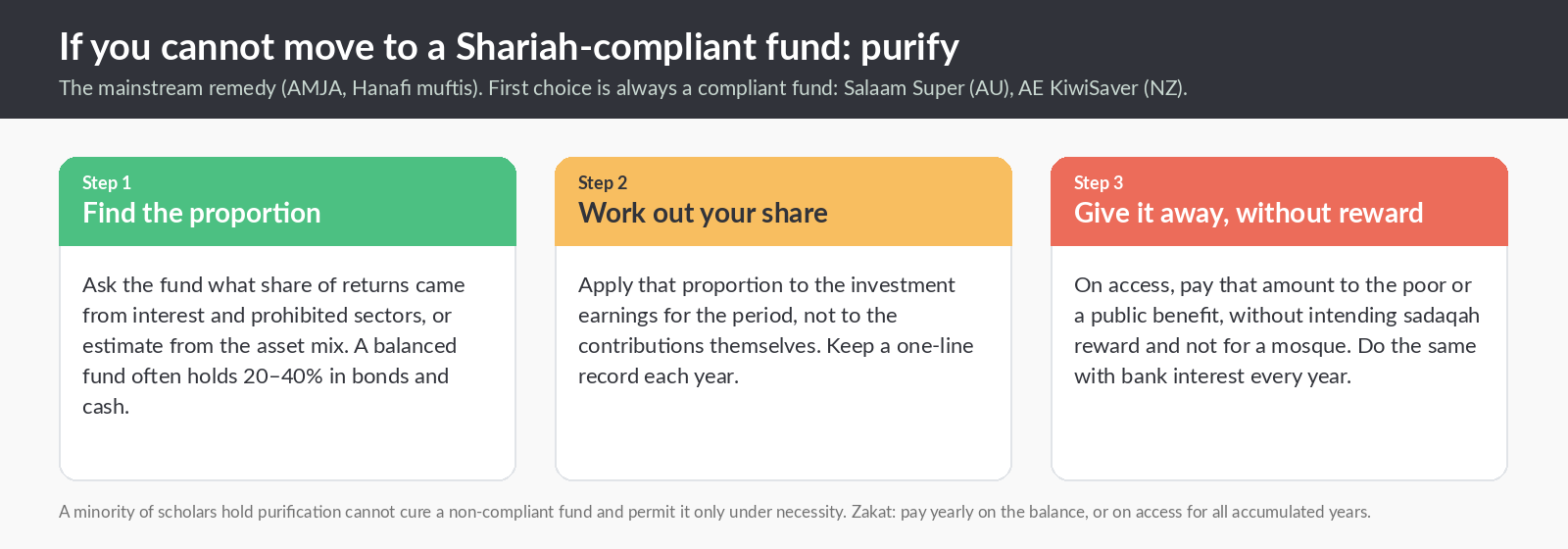
A small number of people cannot move their money: members of a defined-benefit government scheme, an employer-locked fund, or those in a transition period after a fund closes. For them, and only for them, the scholars' remedy is purification: removing from your own benefit the portion of the return that came from prohibited sources. It is a concession for necessity, not a licence to stay in a conventional fund because switching is a bother.
- Find the proportion. Ask the fund what share of its returns comes from interest-bearing assets and prohibited sectors (banks, alcohol, gambling, conventional insurance). Most funds publish their asset allocation; a balanced fund commonly holds 20 to 40 per cent in bonds and cash, which is interest.
- Calculate your share of it. Apply that proportion to the investment earnings (not the contributions) over the period.
- Give it away without reward. When you can access the money, pay that amount to the poor or to a public benefit, without the intention of sadaqah reward for yourself and without using it for a mosque or Qur'an printing; the classical view is that such money is disposed of, not donated in your name. Keep a simple record each year so the figure is ready at withdrawal.
The same rule covers ordinary bank interest. Interest credited to a savings or transaction account is not yours to keep; give it to the needy or a public cause. Do not simply leave it in the account, and do not refuse it in a way that benefits the bank; take it and pass it on.
Zakat on super and KiwiSaver
Views differ on timing, because the money is locked:
- Many Australian scholars, and the National Zakat Foundation (NZF) guide, hold that zakat becomes due once you can access the balance (preservation age or retirement), on the amount you can withdraw.
- Others hold zakat is due every year on the balance, at least on the portion that is yours by right, because it is wealth you own even though you cannot touch it yet.
- Voluntary contributions you chose to make are more clearly zakatable each year than compulsory employer contributions.
A practical approach many scholars accept: if you can afford it, pay zakat yearly at 2.5 per cent on the full balance; if you cannot, pay on access for all the years it accumulated. Record which approach you follow and keep to it.
Frequently asked
My employer only offers a conventional default fund. Am I stuck?
No. In Australia almost all employees can direct super to a fund of their choice; ask for the "Superannuation standard choice form" or nominate Salaam online. In New Zealand you choose your KiwiSaver provider yourself; the employer has no say.
I was a member of Hejaz Islamic Super. What should I do now?
Choose a new fund, preferably a Shariah-certified one such as Salaam, and give its details to your employer so your next contributions do not fall into a conventional default fund. Then follow the Hejaz member portal for the transfer of your remaining balance, which is expected to be completed by the end of February 2027.
What about a government defined-benefit scheme I cannot leave?
Hold it, purify the impermissible portion when benefits are paid, and consider that scholars treat such schemes as a need rather than a choice.
Is the Salaam fund or AE KiwiSaver audited for compliance?
Both publish their Shariah mandates and the identity of their Shariah advisers. Ask for the latest Shariah audit report; a compliant fund will provide it.
Can I invest my super in property or shares myself to avoid interest?
A self-managed super fund (Australia) can hold Shariah-screened shares and property without interest, but it carries costs and legal duties; take advice before going that way.
Sources
- Hejaz Financial Services, what is Islamic super and how it is screened. Link; are "ethical" options Islamic? Link.
- Musaffa Academy, halal stock screening methodologies (AAOIFI and index thresholds). Link.
- Darul Iftaa (Mufti Ebrahim Desai network), superannuation in Australian companies. Link.
- AMJA, investment in 401(k). Link; halal mutual funds and 401(k). Link.
- SeekersGuidance (Shafi'i), investing in a non-compliant retirement fund. Link.
- Crescent Wealth members' transfer to Salaam Superannuation (2024). Link; Salaam Super FAQ. Link.
- Financial Standard, Equity Trustees' super exit and Hejaz Islamic Super. Link; Hejaz member options. Link.
- AE KiwiSaver Plan, statement of investment policy. Link; Mindful Money on the Islamic ethical mandate. Link.
- National Zakat Foundation Australia, zakat on superannuation. Link.
- IslamOnline, what to do with bank interest. Link.
General religious information, not financial advice. Fund names, trustees and mandates change; verify the current Shariah certification before switching. Consult a qualified scholar and a licensed adviser for your own situation.
Have a question of your own?
Ask the Guiding Light Islamic GPT, or contact us for complex personal matters.
Ask a question