Money · Fiqh · Housing
Is a Mortgage Haram? A Muslim's Guide to Buying a Home in Australia and New Zealand
No question reaches us more often than this one. A young couple in Hamilton or Western Sydney, renting for years, watching prices climb, asks: "Is it really haram to take a mortgage? Everyone says there's a fatwa." There is a fatwa. There are several, and they do not all agree. This article sets them out plainly, then turns to what you can actually do on each side of the Tasman.
Why interest is the issue
The Qur'an's prohibition of riba is among the most emphatic in the Book: "Allah has permitted trade and forbidden riba" (2:275), followed by a warning of war from Allah and His Messenger against those who persist (2:279). A conventional mortgage is a loan of money repaid with more money, which is the classical definition of riba al-nasi'ah. That is why the question is serious, and why it deserves a better answer than a clip.
The majority position: prohibited, in any country
The Assembly of Muslim Jurists of America (AMJA), whose members are scholars living and working in the West, ruled in 2009 that a conventional mortgage is "an explicit kind of riba transaction". Islam Q&A, in its Fatwa 101080, states that the majority of scholars prohibit buying a home with an interest-bearing loan whether one lives in a Muslim or a non-Muslim country, and declines to adopt the old Hanafi exception for non-Muslim lands. Australia's own Hanafi muftis, at Darul Ifta Australia in Melbourne and Darul Fatwa in Sydney, answer in the same way.
"Allah has permitted trade and forbidden riba."Qur'an 2:275
Importantly, AMJA did not stop at "no". In 2014 its Resident Fatwa Committee approved buying a home through Shariah-compliant companies using murabahah (cost-plus sale) or diminishing musharakah (shared ownership that the buyer purchases over time). The scholars' objection is to interest, not to home ownership, and not to finance as such.
The minority position: the 1999 European fatwa
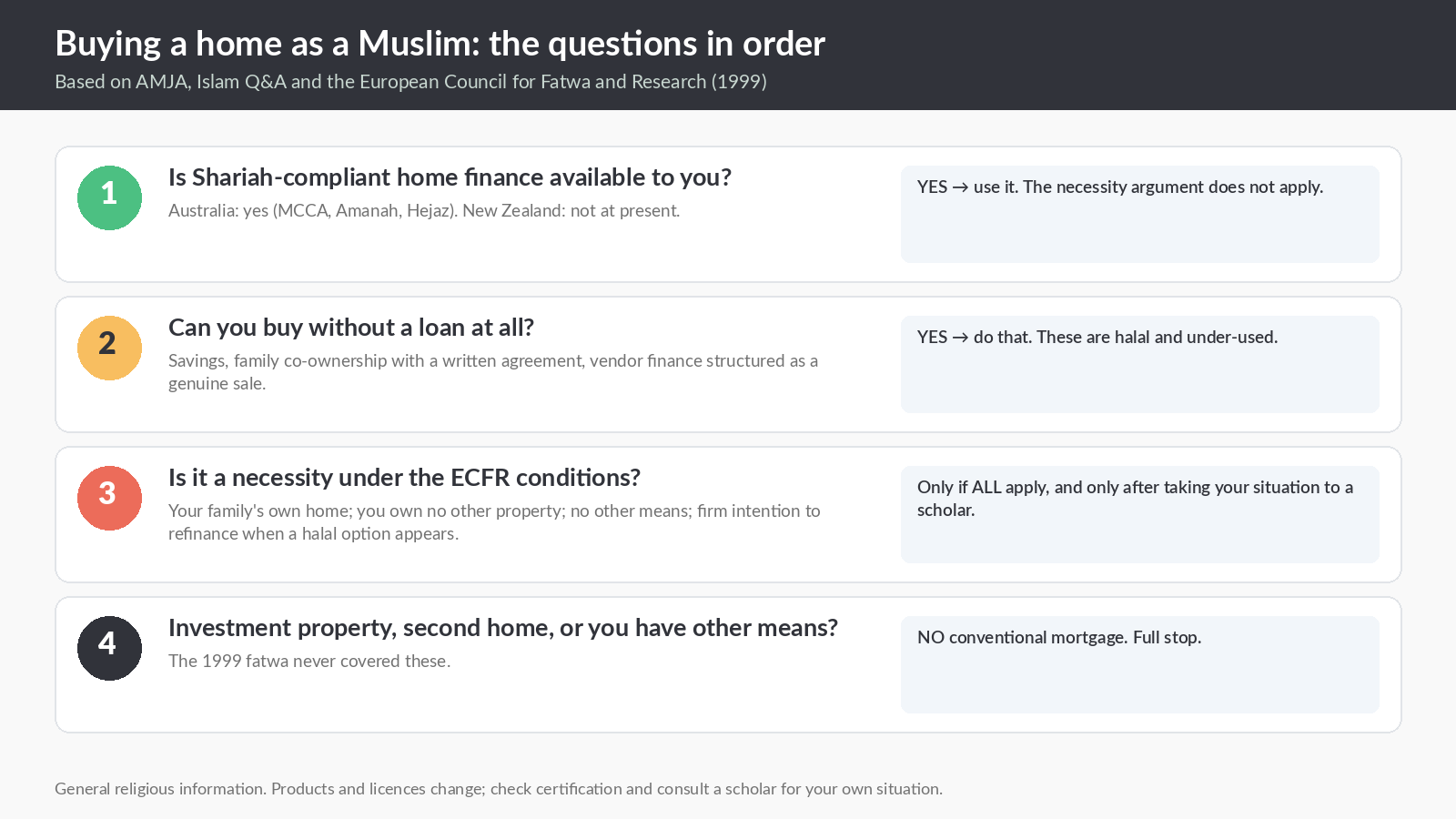
In October 1999 the European Council for Fatwa and Research (ECFR), chaired by Shaykh Yusuf al-Qaradawi, issued the ruling that is quoted in every Muslim WhatsApp group in the West, usually without its conditions. The Council said it saw "no harm in buying mortgaged houses if the following restrictions are strictly observed":
- the house is for the buyer's own family to live in, not an investment;
- the buyer does not already own a house;
- the buyer has no surplus assets that could buy a house another way;
- and, by the Council's own framing, no Islamic alternative is available.
The Council restated that riba is prohibited and "invite[d] the Muslim community to do its utmost to seek Islamic alternatives such as murabahah". It was a necessity ruling for a specific situation: a Muslim family in 1999 Europe with no halal option and no home. Many scholars, including Dr Salah al-Sawi of AMJA, have published detailed critiques of it. Even those who accept it agree it does not cover a second property, an investment unit, or a buyer with other means. And where Islamic finance exists, its central premise falls away.
Australia: the halal options are real
This is the part that changes the answer for Australian Muslims. Shariah-compliant home finance is established here, regulated by ASIC under an Australian Credit Licence like any lender, and increasingly competitive:
- MCCA has provided Islamic finance since 1989 (ACL 388808) and reports more than $3.6 billion in home finance originated.
- Amanah Islamic Finance (ACL 461889) offers ijarah-based home finance and has settled more than $500 million since 2014.
- Hejaz Financial Services provides ijarah home finance through the broker network and in 2025 secured a €100 million funding facility to expand.
These products are not interest loans dressed up. In an ijarah or diminishing musharakah structure the financier buys the property (or a share of it) and you pay rent on the part you do not yet own while buying it out in instalments. The total cost is often a little higher than a bank loan, and that difference is the price of staying within the Shariah. It is also narrowing: Islamic finance here now has scale.
Islamic Bank Australia, which had hoped to become the country's first fully fledged Islamic bank, surrendered its restricted banking licence in March 2024 after falling short of the capital it needed; a relaunch under the name Islamic Money has been reported but not confirmed. Its absence does not change the picture above: the non-bank providers are operating today.
Given that, most scholars hold that the European necessity argument simply does not apply in Australia. If you can obtain Islamic home finance, you should.
New Zealand: an honest gap
New Zealand is different, and we will not pretend otherwise. There is currently no Shariah-compliant home-finance provider operating in the country. A scheme called Manzil was launched in 2007 with a fatwa from the Federation of Islamic Associations of New Zealand (FIANZ) and later lapsed; the New Zealand Bankers' Association said in 2020 that banks were "not seeing that kind of demand"; Amanah's own KiwiSaver literature acknowledged that "there are currently no institutions in New Zealand providing any Shariah-compliant options" for mortgages. EFCO Ltd is Shariah-certified for asset and personal finance, not home loans.
So New Zealand Muslims face the situation the 1999 fatwa was written for. Three positions are held by sincere scholars:
- Apply the ECFR conditions strictly. One family home, no other property, no other means, and a firm intention to refinance into a halal product the moment one exists. Under this view the mortgage is tolerated as a necessity, not endorsed.
- Do not take it. Rent, save, and buy outright or with family. This is the stricter view and it is the safer one in terms of the religion; it is also, for most families in Auckland, very hard.
- Build a halal path without a bank. Shared ownership with relatives under a written co-ownership agreement; vendor finance structured as a sale with instalments at a fixed price, which is permissible when it is a genuine sale and not a disguised loan; community housing cooperatives. These are legitimate and under-used.
Our view is that this is precisely the kind of question that should not be left to individuals and video clips. It is a question for FIANZ and the Ulama Council to answer for New Zealand collectively, in writing, with the conditions spelled out, and for the community's financial professionals to work on a product. Until then, speak to a scholar you trust about your own circumstances before you sign, and do not stretch a necessity ruling to cover an investment property.
If you already have a conventional mortgage
Scholars are gentle here. A contract already signed is not undone by remorse. The guidance is: do not take another; repay it as early as you reasonably can; refinance into a Shariah-compliant product when one is available to you (in Australia, that may be now); and increase charity and seek forgiveness. Past interest already paid is not a debt you can recover; the obligation is to stop, not to despair.
Practical checklist
- Australia: obtain quotes from MCCA, Amanah and Hejaz alongside a bank's. Ask each for its Shariah board's certificate and its structure (ijarah, murabahah, musharakah).
- New Zealand: explore family co-ownership and vendor finance first; if you consider a conventional mortgage, check honestly against all four ECFR conditions and take your situation to a scholar.
- Both: keep the home out of any investment calculation; the necessity argument was never about building a portfolio.
- Both: get the ownership and the will right at the same time (see our guide to Islamic wills).
Frequently asked
Is an Islamic home-finance product just a mortgage with a different name?
No, provided it is properly structured and certified. The financier takes ownership risk and you pay rent on what you do not yet own; there is no loan of money at interest. Ask for the Shariah board certificate and read the contract's structure.
My bank offers an "offset" that reduces interest. Does that help?
It reduces the interest you pay, but the contract is still an interest loan. It changes the amount, not the ruling.
Can I buy a house with my parents or siblings?
Yes. Joint ownership with a written agreement on shares, contributions and what happens on sale or death is permissible and common. Register the shares on the title to match the agreement.
Is renting for life a failure?
No. The Prophet (peace be upon him) rented, and Muslims in many countries rent for life. Ownership is a worldly convenience, not a religious duty; staying clear of riba is.
Sources
- AMJA fatwa 78326, buying a house with a mortgage. Link.
- AMJA Resident Fatwa Committee resolution on Islamic home-financing companies (2014). Link.
- European Council for Fatwa and Research, 4th session (1999), purchasing houses with usurious loans in the West. Text.
- Islam Q&A 101080. Link.
- Darul Ifta Australia on an interest loan to buy a house. Link.
- APRA, revocation of Islamic Bank Australia's restricted licence (2024). Link.
- MCCA mcca.com.au · Amanah Islamic Finance amanah.com.au · Hejaz hejazfs.com.au.
- NZ Bankers' Association on Islamic home loans (2020). Link; Indian Newslink on Amanah and the NZ gap. Link.
General religious information, not financial or legal advice. Products and licences change; check the provider's current Shariah certification. For your own situation, consult a qualified scholar and a licensed adviser.
Have a question of your own?
Ask the Guiding Light Islamic GPT, or contact us for complex personal matters.
Ask a question