Work · Fiqh · Rights
Praying, Jumu'ah and Ramadan at Work: Your Rights in Australia and New Zealand, and What the Scholars Say
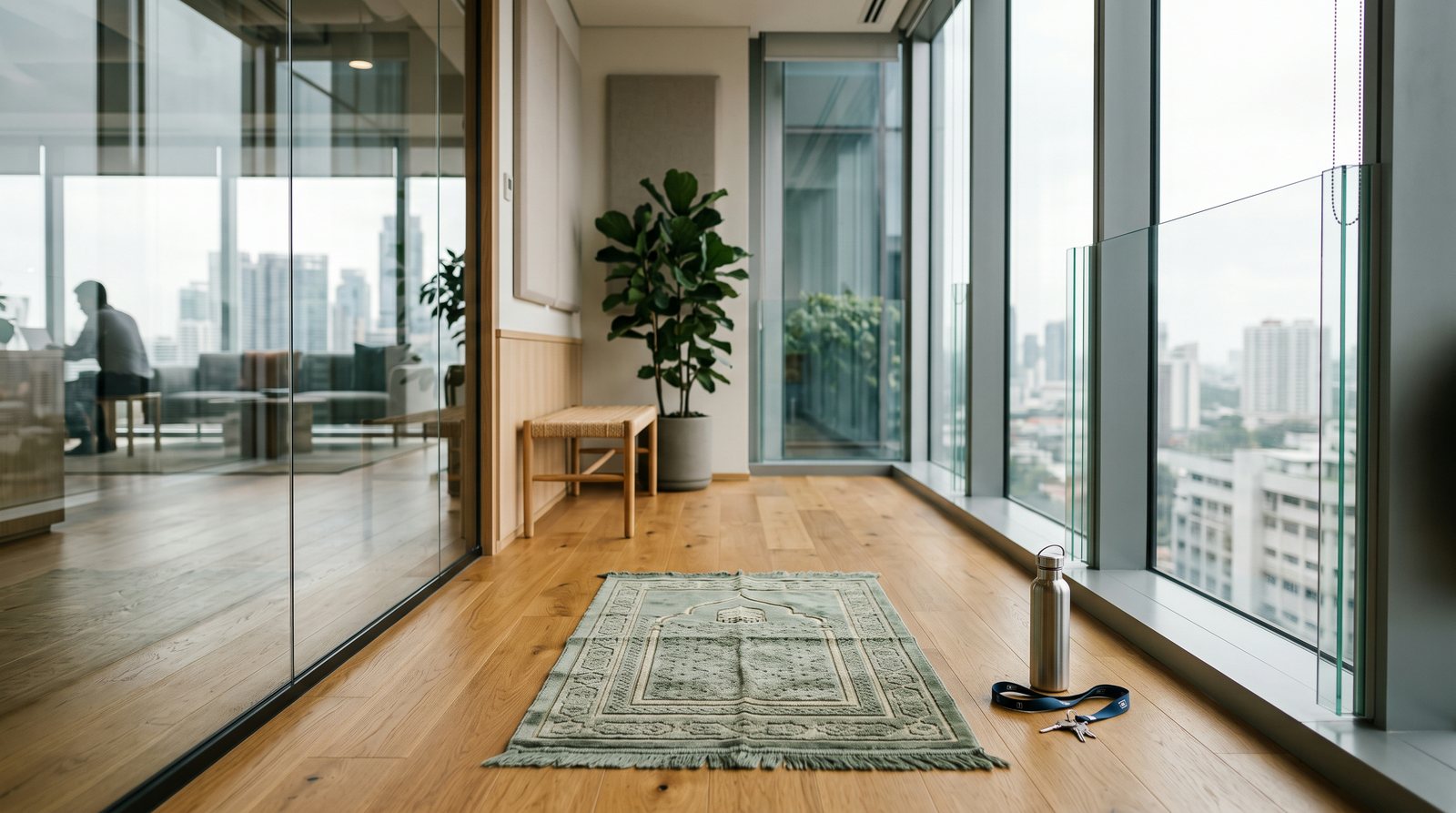
A new graduate on a Wellington building site. A nurse on a twelve-hour shift in Brisbane. A call-centre worker whose breaks are timed to the minute. Each of them asks the same two questions: "Can my employer stop me praying?" and "If I can't pray on time, what do I do?" The first is a legal question with a clear answer. The second is a question of fiqh with more than one answer. This article covers both.
Your legal rights
New Zealand: an explicit duty to accommodate
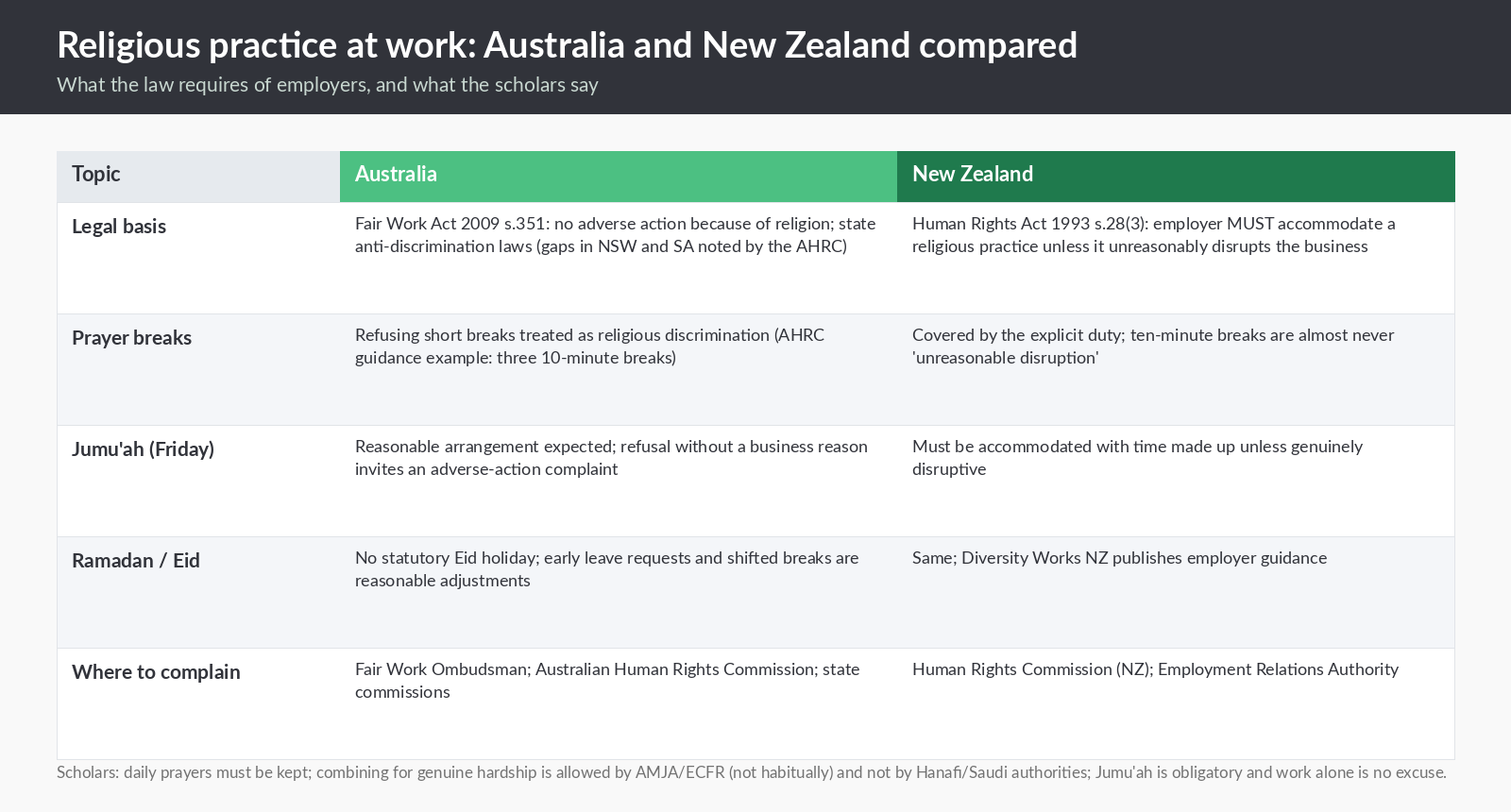
New Zealand's Human Rights Act 1993 is unusually direct. Section 28(3) provides that where a religious or ethical belief requires its adherents to follow a particular practice, "an employer must accommodate the practice so long as any adjustment of the employer's activities required to accommodate the practice does not unreasonably disrupt the employer's activities". This is not merely a ban on discrimination; it is a positive duty. Short prayer breaks, a quiet place to pray, time to attend Jumu'ah, and adjusted hours in Ramadan are the kind of accommodation the section contemplates. An employer who refuses must be able to show unreasonable disruption, which for ten-minute breaks is rarely credible. The Human Rights Review Tribunal has upheld the religious-practice ground before, including an award to a worker dismissed for refusing Sabbath work.
Australia: protection from adverse action
Australian federal law is less explicit but still protective. Section 351 of the Fair Work Act 2009 prohibits an employer from taking adverse action against an employee because of religion; the Australian Human Rights Commission (AHRC)'s workplace guidance uses, as its example of religious discrimination, a Muslim accountant denied a job over three ten-minute prayer breaks. Coverage varies by state (New South Wales and South Australia have gaps in their state laws, which the Commission has noted), but most large employers now provide multi-faith quiet rooms, and the Commission recommends them. The Fair Work Ombudsman and the Commission both accept complaints.
"An employer must accommodate the practice so long as any adjustment of the employer's activities required to accommodate the practice does not unreasonably disrupt the employer's activities."Human Rights Act 1993 (NZ), section 28(3)
What the scholars say about prayer and work
The daily prayers
Each of the five prayers has its time, and praying within it is an obligation that work does not remove. In practice, most jobs only ever collide with two prayers: Zuhr and Asr, and in winter Maghrib. Each takes a few minutes. Scholars across the schools are unanimous that a Muslim must arrange work so the prayers are kept, and that an employer's refusal is a reason to seek a change of role or job rather than to abandon prayer.
Combining prayers when the day truly does not allow it
This is where views differ, and honesty requires setting both out:
- Permitted for genuine hardship, not habit. The Assembly of Muslim Jurists of America (AMJA) holds that "combining prayers may be acceptable to eliminate a great difficulty, as long as it is not made a habit". The European Council for Fatwa and Research permits a worker to combine Zuhr with Asr on short winter days, or Maghrib with Isha in late summer, when the shift genuinely prevents praying each on time, with the same caution that one "should not combine prayers when there is no need, and should not make it a habit". This follows the Hanbali school and the hadith in which the Prophet (peace be upon him) combined prayers in Madinah without fear or rain, which Ibn Abbas explained was "so that his ummah would not be put to hardship".
- Not permitted for work. The Hanafi school does not allow combining outside Arafah and Muzdalifah, and the Saudi Permanent Committee generally prohibits combining for work. Under this view the worker must find a few minutes within the time, pray even briefly, and if impossible, pray as soon as able and seek a different arrangement.
Our advice: know which school or scholar you follow, use the concession only when the day really leaves no room, and never let it become the weekly routine. Most workplaces can give you the minutes if you ask properly.
Jumu'ah is different
The Friday prayer is an individual obligation on adult men, and scholars across schools say that employment is not, by itself, a valid excuse to miss it. The Deobandi and Hanafi muftis are blunt: seek permission from the employer, even with a deduction of pay; if the employer refuses permanently, look for other work. Islamweb and other bodies say the same. In New Zealand, section 28 makes a reasonable Jumu'ah arrangement, say 75 to 90 minutes with the time made up, something the employer must accommodate; in Australia, refusing it without a business reason invites an adverse-action complaint. Women are not obliged to attend Jumu'ah and pray Zuhr instead; many choose to attend when work allows.
Ramadan
Fasting while working is normal and has been for fourteen centuries. Scholars do not treat ordinary work as a reason to break the fast; the exceptions are genuine danger to health or the demands of heavy manual labour in extreme heat, judged case by case. What you can reasonably ask for: an earlier start and finish, a shifted lunch break used for prayer and rest, a break at sunset to open the fast, and flexibility around Eid. Diversity Works New Zealand and a number of Australian employer bodies now publish Ramadan guides for managers; sending one to your manager is a graceful way to open the conversation.
How to ask: a script that works
- Ask early and in writing. On your first week, not the day of. "I'm Muslim and I pray five times a day; two of those fall within work hours and take about ten minutes each. On Fridays I attend a congregational prayer at 1 pm that takes about an hour. I'd like to agree how to fit these in."
- Offer the solution. "I can take my prayer breaks as part of my lunch and tea breaks, and on Fridays I'll start early or stay late to make up the time. A quiet room or an unused meeting room is all I need."
- If refused, ask for the reason in writing and refer to the law: section 28 of the Human Rights Act 1993 in New Zealand, or section 351 of the Fair Work Act 2009 and the Australian Human Rights Commission's guidance in Australia.
- Escalate calmly. HR first; then the Human Rights Commission (NZ) or the Fair Work Ombudsman and the AHRC (AU). Keep a record of dates and responses.
Frequently asked
Is a timed call-centre break enough to pray?
Usually yes: wudu beforehand, a four-rak'ah prayer takes four to five minutes. If breaks are fixed outside the prayer window, ask for one to be moved; that is a small adjustment that section 28 would require in New Zealand.
Can I pray in my car or a stairwell?
Yes. Any clean place is a place of prayer. A quiet room is better and worth asking for, but its absence is not an excuse to miss the prayer.
My job involves long drives. Can I combine?
Travel beyond the distance of a journey (about 80 km by the common estimate) permits combining and shortening under all schools. For local driving, the rules above for work apply.
Can my employer make me take leave for Eid?
Eid is not a public holiday in either country, so a day's leave is normally required, but refusing a reasonable, early request for a religious holiday without good reason is the kind of adverse treatment the law addresses. Ask early; many employers allow a swap with another public holiday.
Sources
- Human Rights Act 1993 (NZ), section 28. Act text; Hesketh Henry commentary on competing rights at work. Link.
- Fair Work Ombudsman, protection from discrimination at work. Link; Fair Work Commission on section 351. Link.
- Australian Human Rights Commission, workplace discrimination guide. Link; freedom of religion factsheet (2019). Link.
- AMJA on combining prayers. Link; AMJA on the schools' positions. Link.
- Summary of ECFR and Permanent Committee views on combining for work. Link.
- Jumu'ah and employers: Islamweb 82624. Link; Darul Ifta Deoband. Link.
- Diversity Works NZ, Ramadan in the workplace. Link; SBS on Ramadan and Australian employers. Link.
General religious and legal information, not legal advice. For a dispute with an employer, contact the Human Rights Commission (NZ), the Fair Work Ombudsman or the Australian Human Rights Commission, or an employment lawyer.
Have a question of your own?
Ask the Guiding Light Islamic GPT, or contact us for complex personal matters.
Ask a question