Family · Fiqh · Thought
Islam as a Living Religion: Iqbal, Collective Ijtihad and the Two-Income Muslim Household
A couple in Auckland, both professionals, both Muslim. He says the home is his duty and her salary is her business. She agrees, and adds that he has no right to ask where her money goes. Six months later the mortgage, the childcare and the resentment are all growing. Each of them can quote a scholar. Neither of them has read a ruling.
This article is about that argument, but it is really about something bigger: how Muslims living in Western countries get clear answers to new questions, and why a Punjabi philosopher who died in 1938 saw the problem coming.
The argument in Muslim homes
The classical position is well known and, in its core, undisputed. A husband is responsible for his wife's maintenance (nafaqah): food, housing and clothing, measured by his means. "Let a man of wealth spend from his wealth, and he whose provision is restricted, let him spend from what Allah has given him" (Qur'an 65:7). A wife's property, including her earnings, is her own. She owes nothing from it to the household.
Both of those statements are true. The trouble starts when each spouse holds one of them like a shield. A husband who leans on "her money is hers" to mean "so she can't complain about my spending" is misusing the ruling. A wife who leans on "the home is his duty" to refuse any cooperation, even when both incomes are needed to live in Sydney or Wellington, is also misusing it. Most of the couples we hear from are not asking what the rule is. They are asking how two people who both leave the house at 7:30 am are supposed to live under a rule written for a world where one of them stayed home.
What Iqbal saw a century ago
In 1930 Muhammad Iqbal delivered six lectures in Madras, Hyderabad and Aligarh, published as The Reconstruction of Religious Thought in Islam. The sixth lecture, The Principle of Movement in the Structure of Islam, is the one that matters here. Its argument fits in one sentence of his: "What then is the principle of movement in the structure of Islam? This is known as Ijtihād."
Iqbal's starting point was that a Muslim society "must possess eternal principles to regulate its collective life, for the eternal gives us a foothold in the world of perpetual change." But he immediately added the warning that gives the lecture its force:
"Eternal principles when they are understood to exclude all possibilities of change which, according to the Qur'an, is one of the greatest 'signs' of God, tend to immobilize what is essentially mobile in its nature." Muhammad Iqbal, Reconstruction, Lecture VI
He did not think the law of Islam was frozen by nature. He thought it had been frozen by history: by the reaction against the early rationalists, by the retreat of the best minds into other-worldly Sufism, and by the fear that followed the destruction of Baghdad in 1258, when "the conservative thinkers of Islam focused all their efforts on the one point of preserving a uniform social life for the people by a jealous exclusion of all innovations." He called the closing of the gate of ijtihad "pure fiction," and he was blunt about the result:
"The claim of the present generation of Muslim liberals to reinterpret the foundational legal principles, in the light of their own experience and the altered conditions of modern life is, in my opinion, perfectly justified. The teachings of the Qur'an that life is a process of progressive creation necessitates that each generation, guided but unhampered by the work of its predecessors, should be permitted to solve its own problems." Muhammad Iqbal, Reconstruction, Lecture VI
Not individuals: an assembly
The part of Iqbal's argument that is most often missed is that he did not want ijtihad done by lone scholars, let alone by lone preachers with a camera. He called ijma, consensus, "perhaps the most important legal notion in Islam," and lamented that it "remained practically a mere idea, and rarely assumed the form of a permanent institution in any Muhammadan country." His explanation was political: the Umayyad and Abbasid rulers preferred to leave ijtihad to scattered individuals "rather than encourage the formation of a permanent assembly which might become too powerful for them."
His remedy was to transfer the power of ijtihad "from individual representatives of schools to a Muslim legislative assembly," in which the ulema "should form a vital part" and which would also draw on "laymen who happen to possess a keen insight into affairs." And he named the safeguard against error: "to reform the present system of legal education in Muhammadan countries, to extend its sphere, and to combine it with an intelligent study of modern jurisprudence."
That is the heart of what Iqbal meant by the reconstruction of religious thought. It was never a call for individuals to improvise, and it was not a call to change the principles of Islam. It was a call for the Muslim world's scholars and research centres to sit together as a standing body, identify the questions that are actually confusing ordinary Muslims in each age, especially the social and economic ones, study them with the best knowledge of the day, and reach a consensus on guiding principles that the masses can follow with confidence. Ijtihad done that way becomes ijma: not one centre's opinion, but the agreed position of the ummah's scholarship.
He even discussed the economics of marriage
It is striking that in the same lecture Iqbal turned to women's economic position. Defending the Qur'anic inheritance shares against a Turkish poet's criticism, he pointed out that the daughter's smaller share sits inside a larger system in which "the responsibility of maintaining her throughout her life is wholly thrown on the husband." Then he added a sentence that reads like a brief for our subject:
"The principles underlying the Qur'anic law of inheritance… have not yet received from Muslim lawyers the attention they deserve. Modern society with its bitter class-struggles ought to set us thinking; and if we study our laws in reference to the impending revolution in modern economic life, we are likely to discover, in the foundational principles, hitherto unrevealed aspects." Muhammad Iqbal, Reconstruction, Lecture VI
The two-income household is exactly that revolution. Iqbal saw that maintenance, inheritance and dower form one economic design, and that when the economic life around that design changes, the scholars have to study it again, together.
Did anyone listen?
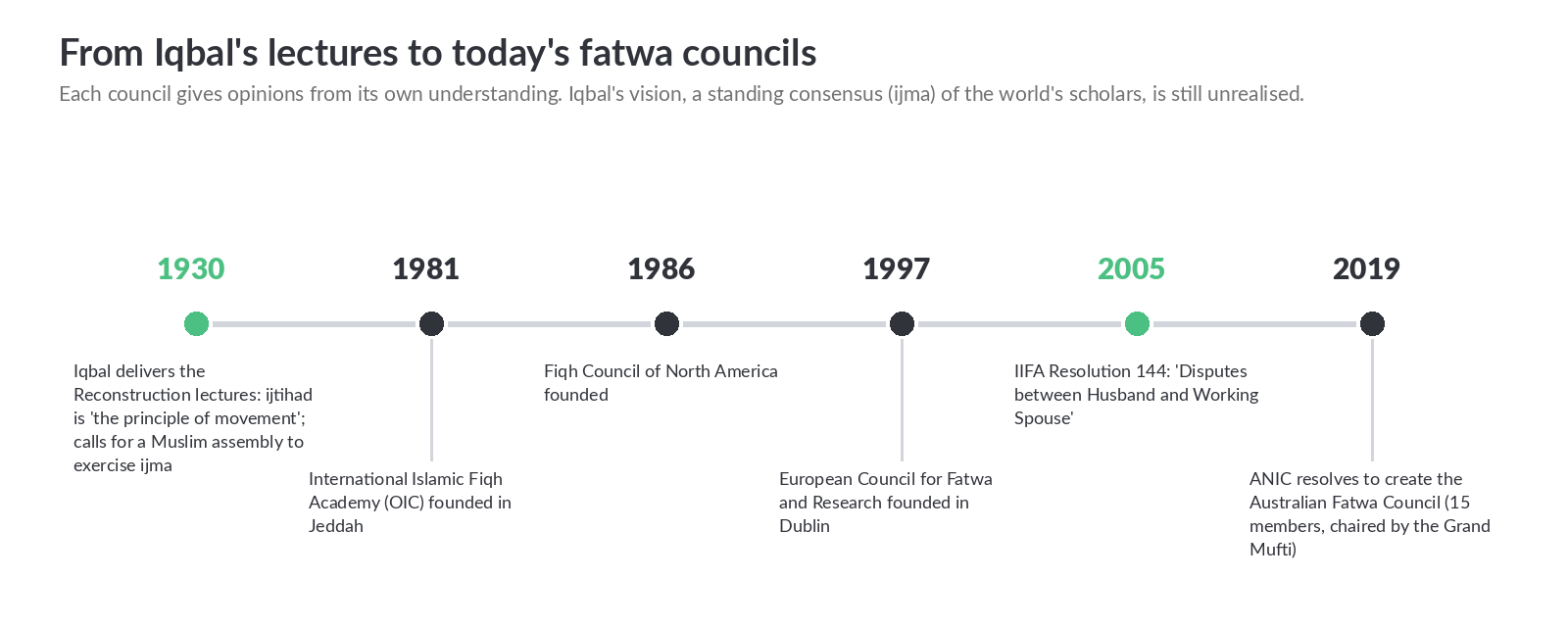
Only in part. Since Iqbal's lectures a number of fatwa bodies have been founded: the International Islamic Fiqh Academy (IIFA) of the Organisation of Islamic Cooperation in Jeddah in 1981, the Fiqh Council of North America in 1986, the European Council for Fatwa and Research in Dublin in 1997, and closer to home the Australian Fatwa Council, which the Australian National Imams Council (ANIC) resolved to create in 2019, now fifteen members chaired by the Grand Mufti. A whole field, fiqh al-aqalliyyat, the jurisprudence of Muslim minorities, developed by Taha Jabir al-Alwani and Yusuf al-Qaradawi, rests on the premise that classical fiqh assumed Muslim-majority societies and that Muslims in the West need fresh thinking.
These are valuable, but it is important to be precise about what they are. Each is a regional or institutional body giving its opinion according to its own understanding and school. They do not sit together, they do not reconcile their differences, and no mechanism joins them into the consensus Iqbal described. That is why a Muslim in Auckland can find three different answers to the same question from three respected councils and have no way to tell which carries the weight of the ummah. The International Islamic Fiqh Academy, which draws scholars from across the OIC's member states, is the nearest thing to Iqbal's assembly, but even its resolutions are advisory, it meets about once a year, and it has no standing research arm working between sessions.
Then there is the question of who hears any of it. Academic studies of the European Council found that most Muslims in Europe did not know its rulings existed. Meanwhile the questions keep arriving, and people answer them from the clips on their phones, which is precisely the fragmented, individual ijtihad that Iqbal thought the old rulers had deliberately preserved.
What the scholars' councils have ruled on the working wife
Here is the good news: on this question, the body closest to Iqbal's idea has already spoken. In April 2005 the International Islamic Fiqh Academy, meeting in Dubai with scholars from across the Muslim world, issued Resolution 144 (2/16), Disputes between Husband and Working Spouse. It is short, clear and freely available, and it answers almost every version of the argument in our opening paragraph.
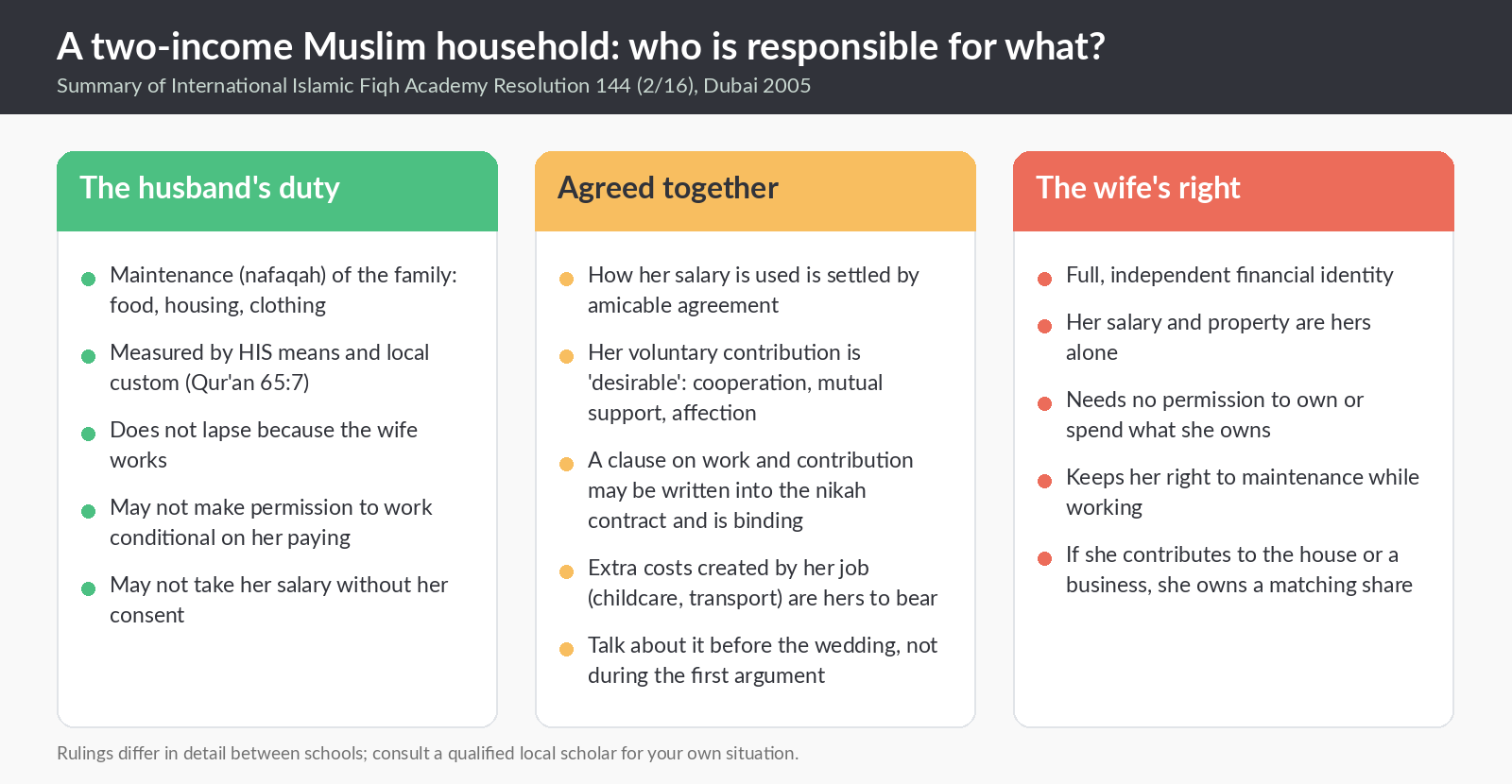
The resolution holds that:
- The wife has "an independent financial identity." Her husband "has no authority over her properties," and she "needs not any permission from her husband to own or to dispose of what she owns."
- Maintenance remains the husband's duty, "determined according to the financial capability of the husband," and she does not lose it by taking a job.
- She cannot be forced to contribute. "It is not obligatory for the wife to contribute to the household expenses as they are initially assigned to the husband, and therefore, she should not be forced to do so."
- But contribution is encouraged, and agreement is the method. Her voluntary contribution "is desirable in Shariah because it involves cooperation, mutual support, and affinity," and "it is permissible for the couple to amicably agree on what they are going to do with the salary or wage earned by the wife."
- The costs her job creates are hers. "When the performance of the outdoor job of the wife results in additional expenses relating to it, such additional expenses should be borne by the wife."
- A husband may not sell his permission. It is prohibited for him to make his consent to her working "conditional upon her contribution to living expenses… or upon giving him part of her salary."
- Contribution creates ownership. If she contributes to buying a house or a business, "she is entitled to a share in that property commensurate to her actual contribution."
- Stipulations are binding. A clause in the marriage contract about her right to work, if the husband accepts it, "he is required to abide by it."
Other fatwa bodies say the same. Islam Q&A (2001) holds that unless the marriage contract says otherwise, "the household expenses are all the responsibility of the husband," then advises couples to "agree upon something between yourselves, such as one half of the salary, or one-third, or one-quarter," so that "love and harmony may take the place of conflict." Egypt's Dar al-Ifta, Jordan's Iftaa Department and Hanafi scholars at SeekersGuidance all concur on the core: his duty does not lapse; her salary cannot be taken without her consent; a willing contribution is a kindness, not a debt.
So who is right?
Both spouses in our opening story are half right, which is why they are fighting. Read together, the rulings give a settled picture:
- The husband's obligation to provide does not transfer to the wife because she earns. A husband who treats his wife's salary as a household fund he can draw on is going against the explicit text of the resolution.
- Her earnings are hers, but "mine" in Islam is not the end of the conversation. The Qur'an describes spouses deciding "by mutual consent and consultation" (2:233) and commands living together "in kindness" (4:19). A wife who can afford to help and refuses on principle is within her strict right and outside the spirit of the ruling, which calls her contribution desirable and a source of affection.
- The extra costs of a two-income life, childcare above all, are not simply the husband's. The resolution assigns the costs created by her job to her.
- Whatever the couple agree is binding on both of them. The councils keep returning to the same instrument: talk, agree, and if possible write it into the marriage contract.
The state already treats you as one household
There is a further fact of Western life that the "her money is hers" argument ignores, and it is exactly the kind of "altered condition" Iqbal said each generation must reckon with. Welfare systems in Australia and New Zealand do not see two financially separate adults. They see one household.
In Australia, a person applying for JobSeeker must declare their partner's income as well as their own, and a partner's earnings above a threshold reduce the payment, down to nothing if the partner earns enough. New Zealand's Ministry of Social Development has stated that the law requires it "to take all income received by either spouse or de facto partner into account" when setting a benefit, with no discretion to do otherwise; a couple's joint earnings above a modest weekly amount cut each partner's Jobseeker Support, and a couple whose combined income passes the ceiling receives nothing.
Consider what that means in practice. A husband loses his job. His wife earns a good salary. The state says, in effect, "your household can live on her income," and declines to help. If she now insists that her salary is hers alone and the home remains his duty, the family has no income at all: not from him, not from her, and not from the state. No council of scholars has ever endorsed that outcome, and the Qur'an's command that spouses live together in kindness forbids it.
The welfare rule does not change the fiqh. The husband's duty stays his, and her money stays hers. What it changes is the context in which the couple's agreement is made. When the law of the land treats your incomes as one pool for the purpose of support, a marriage that treats them as two sealed boxes is living in a different country from the one it actually inhabits. This is why the scholars' councils keep returning to agreement and consultation rather than to a fixed formula: the right answer in Jeddah in 1980 and the right answer in Auckland today share the same principles and cannot share the same arithmetic.
What an Iqbalian answer looks like here
Iqbal's full vision is larger than any one country: the scholars and research institutions of the Muslim world sitting together as a standing body, with economists, lawyers and social scientists alongside the jurists, choosing the handful of questions that confuse Muslims most in each generation, studying them properly, and publishing an agreed position that imams everywhere can teach. On this question the 2005 resolution shows what such a body can produce, and its unheeded call for research into the effects of wives' work shows what is still missing: the follow-through. Until that worldwide consensus exists, communities such as ours can at least act in its spirit. For Muslims in New Zealand and Australia, that could mean:
- Plain-language guidance from our own councils. A one-page explanation of the dual-income household, based on Resolution 144, with worked examples, published where ordinary couples will find it.
- A model clause for the nikah contract on work, contribution and shared property, offered by mosques as standard.
- Pre-marriage courses that put the financial conversation on paper while it is still easy.
- Iqbal's "laymen with keen insight": economists, family counsellors and lawyers sitting with the ulema, and real data gathered from Muslim families in the West, fed back to the international bodies so that the next consensus is better informed than the last.
That is Islam as a living religion in practice, and it is what Iqbal meant by reconstruction. The principle stays fixed: a husband provides, and a wife's property is her own. The application to a two-income life in Auckland or Melbourne is worked out openly, collectively and in writing, by scholars in consensus rather than by preachers in competition, so that two tired people at a kitchen table are not left to settle a question of law on their own.
Frequently asked
My wife earns more than I do. Am I still responsible for the household?
Yes. The councils are explicit that the duty is measured by the husband's means, not the wife's, and that it does not lapse because she works or earns more. She may choose to contribute, and the scholars encourage it, but it remains her choice unless the two of you agreed otherwise.
Can my husband insist I hand over part of my salary as a condition of letting me work?
No. Resolution 144 prohibits making permission to work conditional on contribution. A freely made agreement between you is different, and binding.
We both pay the mortgage. Whose house is it?
Under the resolution, each spouse owns a share matching their actual contribution. Keep records, and consider having the title reflect it.
My husband is out of work and Centrelink / Work and Income says my income is too high for him to get a benefit. Must I support him?
The strict ruling is that maintenance is his duty, not yours, and the councils say a wife cannot be forced to contribute. But the same councils call her contribution desirable and a mark of mutual support, and the Qur'an commands kindness between spouses. When the state has already decided that your household lives on your income, refusing to feed your husband and children is not a position any scholar defends. Most scholars would say: support the family now, and when he is earning again his duty resumes in full. Many couples also treat what she spends in such a period as a loan or a gift by clear agreement, so that neither of them feels wronged later.
Is a verbal agreement enough?
Islamically, yes, but memories fade and circumstances change. Write it down, ideally in the marriage contract, and revisit it when children arrive or incomes change.
Sources
- Muhammad Iqbal, The Reconstruction of Religious Thought in Islam, Lecture VI, "The Principle of Movement in the Structure of Islam" (1930). Iqbal Academy text.
- International Islamic Fiqh Academy (OIC), Resolution No. 144 (2/16), "Disputes between Husband and Working Spouse", Dubai, 9 to 14 April 2005. Full text.
- Islam Q&A, Fatwa 2686, "If a woman works, does she have to pay the household expenses?" (2001). Link.
- SeekersGuidance, "Does a working wife lose her right to nafaqa?" (Hanafi). Link.
- Iftaa' Department, Jordan, "What is the Islamic ruling when the husband takes his wife's salary?" Link.
- Dar al-Ifta al-Misriyyah, "Does my husband have the right to take my salary?" Link.
- Services Australia, JobSeeker Payment: income and assets tests (partner income must be declared and affects the payment). Link.
- Work and Income NZ, Jobseeker Support for couples: deduction tables. Link; Ministry of Social Development, OIA response R-20200526 on couple applications declined for excess income. Link.
- Australian National Imams Council, Australian Fatwa Council members. Link.
- On the European Council for Fatwa and Research and minority fiqh: Fiqh al-aqalliyyat; Does the ECFR matter? (Dortmund study).
This article offers general religious information. Rulings differ in detail between schools of law and individual circumstances vary. For your own situation, speak to a qualified scholar; for property and contracts, speak to a lawyer.
Have a question of your own?
Ask the Guiding Light Islamic GPT, or contact us for complex personal matters.
Ask a question